An analysis of Professor Cynthia Dwork’s acceptance address for the World Leader in AIWS Award 2026 at the Boston Global Forum Conference on November 10, 2026
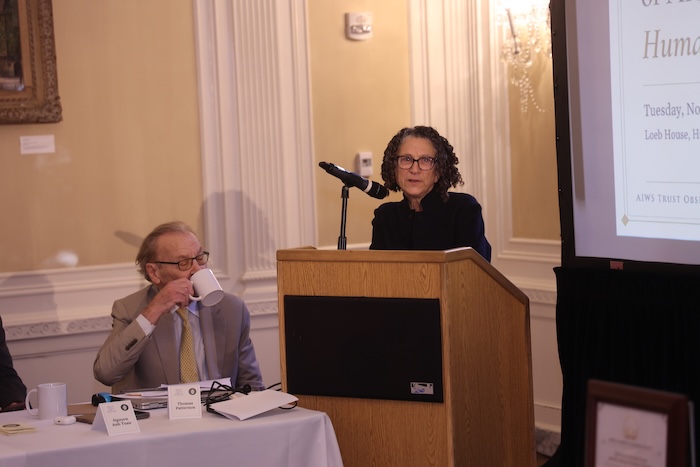
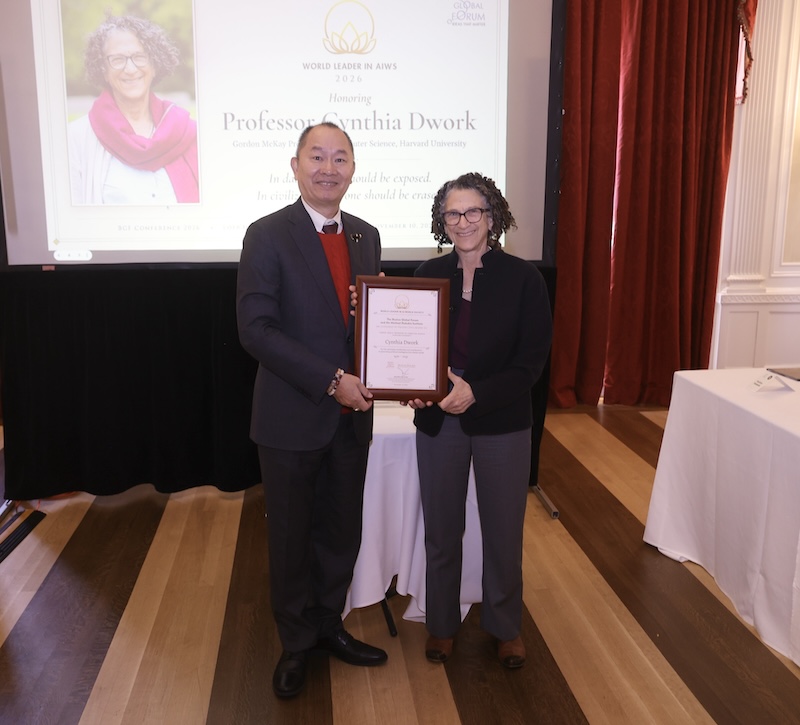
At the Boston Global Forum Conference at Loeb House, Harvard University, on November 10, 2026, Professor Cynthia Dwork was honored with the World Leader in AIWS Award 2026. She said she was honored to receive the award. In her acceptance address, she turned to a fundamental question for the AI age: what must an AI system demonstrate to deserve public trust?
An AI system can meet a standard and still fail to protect people as intended. The standard itself may overlook a setting, an attack or an essential safeguard. This was the starting point of Professor Cynthia Dwork’s argument at the Boston Global Forum conference at Harvard on November 10, 2026, and a fundamental challenge to anyone assessing whether AI deserves public trust.
In response to the question of what evidence could justify public trust, she offered a method: define what must be guaranteed, examine the basis of that definition, require proof and testing, and consider opportunities to intervene once the system enters everyday life. The address also established an important boundary: science clarifies which choices are possible; society must decide which choices are acceptable.
Definitions are the foundation of trust
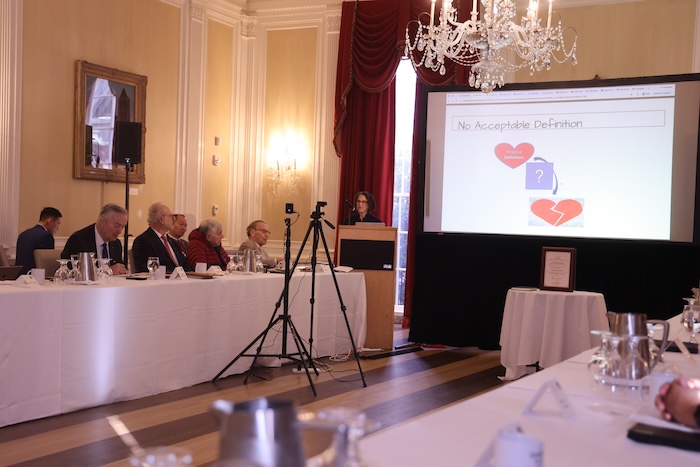
Dwork began with the history of cryptography. Her first slide depicted an earlier cycle: someone proposes a cryptographic system, someone else breaks it, and a new system follows. Modern cryptography begins by defining the protection to be achieved. Researchers then construct algorithms and prove that, under stated assumptions, those algorithms satisfy the definition.
This approach separates two questions often treated as one: does the algorithm deliver its promised guarantee, and is that guarantee sufficient? A correct proof does not establish that the original objective covered every situation that matters.
Her example was concrete. An adversary who merely listens to a conversation differs from one who participates maliciously in a cryptographic protocol. A definition designed for the first situation may leave the second unaddressed. In that case, the protection model needs revision even if the original proof remains sound.
The lesson for AI is that safety, fairness and privacy must have meanings precise enough to examine. Evaluators need to know whom a system protects, against what, in which circumstances and under which assumptions. Without those answers, a certification label offers a fragile basis for trust.
Making progress accumulate
Her next slides showed researchers challenging definitions, developing stronger ones and finding algorithms that satisfy them. An upward arrow on the third slide captured the significance: new understanding should produce stronger protection, turning repeated challenges into cumulative progress.
This is also a way to learn from failure. An incident may reveal that a system violated its existing guarantee, or that the guarantee never covered the circumstances in question. These failures demand different responses. Treating them alike risks repairing a symptom while leaving the underlying gap intact.
For the AIWS Trust Observatory, this suggests a role beyond recording whether a system passes a test. It could track how definitions and evidence evolve: what was previously guaranteed, which limits have emerged and what must change. This is an application of Dwork’s reasoning, rather than a procedure she announced or the conference formally adopted.
When mathematical limits become democratic questions
Dwork then considered a harder case: what if no algorithm can be found that satisfies the definition? Researchers must investigate why. The obstacle may reflect current knowledge, or the problem may be provably impossible. A weaker or different definition might make it solvable. Yet there may be no solution that is both implementable and acceptable.
She illustrated the difficulty through algorithmic fairness in creditworthiness scoring. Some statistical requirements concerning equality between groups seem natural, yet cannot all be achieved simultaneously. Her point concerned conflicts among particular requirements, rather than the impossibility of fairness in every form.
Deciding which guarantee to prioritize, which tradeoff to accept or whether deployment should proceed is then no longer a purely mathematical task. Dwork placed these questions within democracy, participation and power. Who participates in the choice? Who benefits? Who bears the remaining risk?
This has important implications for the Constitution for Humanity in the Age of AI. Her argument suggests that governance must establish who may decide tradeoffs technology cannot resolve on its own. Scientific expertise should help people understand the alternatives. Legitimate decisions require human participation and accountable institutions.
An agenda for independent evaluation
Returning to the work of an observatory, Dwork proposed starting with the actual problem being solved and the guarantees a system provides. Those guarantees should be explained in ordinary language, together with their translation into mathematical definitions.
She called for examining how the definition was developed: who chose it, on what basis, and why it was prioritized when desirable requirements cannot coexist. Evaluation must therefore reach both the scientific basis and the reasons for selecting a particular protection objective.
Next come evidence that the system satisfies its definition, methods of testing in the real world and points at which people can intervene to change the system. Taken together, these questions require several forms of assurance: a model and supporting proof, observation during deployment and the capacity to make corrections.
One possible application for the Observatory, developed from these questions, would be to require each trust claim to carry a record of its guarantee, assumptions, evidence, limits and means of intervention. Where a formal proof is unavailable, the record should accurately describe the kind of evidence that exists and what cannot yet be concluded. Test results should not be presented as unconditional guarantees.
The final slide in the supplied file, titled Tuan’s Questions, asks about evidence, transparency alongside personal-data protection and a scientific priority for 2027. In the speech segment examined here, Dwork concentrated on method and governance. She did not offer a detailed differential-privacy implementation or select a single first-year project. Her contribution establishes how to ask and evaluate the questions, rather than presenting a completed standard ready for adoption.
Dignity must be built into the system
Dwork warned of fundamental limitations in relying on monitoring prompts or responses to ensure safety. Systems must respect dignity by design. She did not identify a particular theorem or its conditions in this passage, so the warning should not be expanded into a claim that every filter is useless. Its practical force is that an external monitoring layer cannot simply be assumed to provide adequate protection for human dignity.
She also raised an often neglected investment question: what fraction of the budget supports human good? Such work requires cryptographers, theorists and engineers. Safety and fairness demand resources, expertise and sustained effort.
The Observatory could therefore examine whether resources match commitments. A large budget is not itself proof of safety. Investment enables responsibility to be carried out; results still require verification.
Human power belongs in the trust equation
Dwork concluded by emphasizing the role of government and antitrust law. In her account, antitrust strengthens consumer power as well as lowering prices. Placed at the end of her argument, this point extends the trust question from a system’s quality to the social conditions in which people must use it.
A reasonable implication is that trust should be considered alongside users’ ability to choose and influence outcomes. Where people have no alternative, cannot contest decisions or lack influence over important rules, their dependence on a technology does not establish that they trust it.
The slide Our Decisions shows an ocean liner. Notes in the supplied deck contrast responsible scaling with irresponsible scaling and having enough lifeboats for everyone with failing to provide them. They connect these choices to government’s duty to protect people and to democratic decision-making. This supplementary material reinforces the speech’s argument about responsibility.
For BGF–AIWS, Dwork’s contribution gives trust a foundation open to scrutiny: what is guaranteed, how far the evidence reaches, which limits remain, who decides and who can intervene. A new civilization needs the capacity to recognize both what technology can accomplish and what society must retain the authority to decide. Mature trust begins with that clarity.
Sources: Video of the BGF Conference, November 10, 2026, segment 16:14–27:00; the substantive remarks run approximately 17:09–26:40. The slide deck AIWS (Dwork) short (1).pptx contains eight slides with accompanying notes. The proposed applications to the Observatory and Constitution in this article are analysis, not quotations or conference resolutions.
Watch Cynthia Dwork’s address — 16:14–27:00
Full conference video:
An analysis of Professor Cynthia Dwork’s acceptance address for the World Leader in AIWS Award 2026 at the Boston Global Forum Conference on November 10, 2026