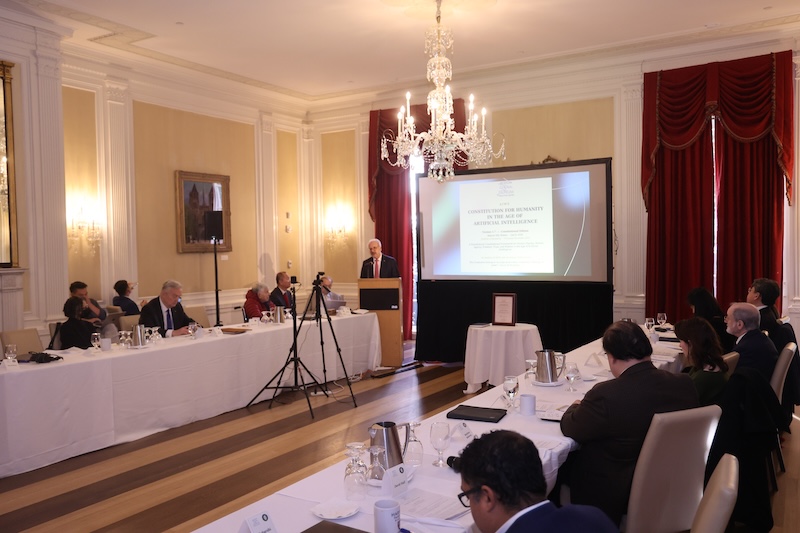
President Egils Levits at BGF on constitutional legitimacy, mental sovereignty and the institutions that make rights real
A society may retain its formal rights while losing something essential to exercising them: the ability of people to think and judge independently. At the Boston Global Forum conference at Harvard University’s Loeb House on November 10, 2026, President Egils Levits placed this danger at the center of the constitutional challenge posed by artificial intelligence.
The former President of Latvia and former Judge of the Court of Justice of the European Union offered a substantive assessment of the Constitution for Humanity in the Age of Artificial Intelligence. He explained why a document without a state behind it could acquire influence, welcomed its protection of mental sovereignty, and identified the institutional work still needed to defend its rights.
His prepared address, A Constitution with Many Authors, supplied the framework. Speaking at the conference, he said that the text was available to participants and chose to develop selected points rather than read it aloud. His additional remarks sharpened the question underlying the project: who will control the power that AI places in human hands?
Democratic trust requires the power to challenge
Levits opened his oral remarks with a deliberately challenging account of democracy as “institutionalized mistrust.” Democratic government creates ways to question power, expose failures and correct them. In his argument, this capacity for correction helps explain democracy’s long-term strength, even when authoritarian systems appear to deliver particular results more quickly.
He applied the same reasoning to technological companies whose growing power lies outside democratic control. Society, he argued, must decide whether to accept claims that this power should remain unchecked. The issue concerns the authority of the organizations deploying AI as much as the capabilities of their systems.
He also challenged the assumption that disruption is inherently beneficial. Disruption deserves support when what follows is better. Where its effects are mixed, society must distinguish desirable gains from harmful consequences. He identified law as democracy’s principal instrument for making that distinction, while acknowledging that enforcing law becomes more difficult in the AI age.
For the AIWS trust agenda, the implication is significant: confidence should rest on institutions that permit scrutiny and correction. This is an interpretation of his argument, rather than an institutional arrangement announced at the conference.
A constitution can gain authority before it gains enforcement power
Levits organized his constitutional assessment around three questions: can the document bind without a state, what must its preamble protect, and how will its rights be defended?
His prepared address drew on Latvia’s experience. During the occupation from 1940 to 1990, Latvia’s constitutional order retained its legitimacy despite the loss of the power to enforce it. The restoration of independence in 1990 restored a legal order rather than creating a new state. He distinguished that history from the task facing the proposed AI constitution, which must build acceptance of a new framework and translate acceptance into obligations.
The connection was the possibility that constitutional fidelity can precede formal constitutional force. In practical terms, Levits described the proposed Constitution as soft law: a normative document capable of influencing conduct without possessing the binding legal authority of a national constitution or treaty.
He offered three tests for its influence: legitimacy, credibility and usefulness. In his judgment, the draft met all three. He pointed to BGF’s consultation of relevant expertise and the grounding of its rights in ethical principles and human-rights standards. He considered the document credible because it reflected current debate, and useful because it translated principles into guidance that people, organizations and policymakers could apply, assess and update.
This was a qualified but consequential endorsement. Levits did not claim that the draft already carried legal force. He argued that broad discussion and acceptance could give it real political weight. In his oral remarks, he invoked the influence of the Universal Declaration of Human Rights to illustrate how a declaration can matter profoundly without itself being a binding treaty.
Protecting the human capacities on which rights depend
The most distinctive part of Levits’s assessment concerned independent thought. He described threats to people’s ability to think and judge for themselves as insufficiently recognized in the wider discussion of AI. He welcomed mental sovereignty as a legal concept through which that concern could be articulated.
His prepared address elaborated the point through the proposed rights to mental sovereignty, truth and information integrity, and protection against cognitive manipulation. Their shared purpose is to safeguard the human capacity to form judgments independently and critically.
This takes the constitutional discussion beyond the consequences of an individual automated decision. A person must retain the capacity to understand a decision, assess competing claims and decide whether to challenge authority. If those capacities are eroded, the practical foundation of other rights weakens with them.
Levits’s contribution therefore places a demanding question before the constitutional project: how can protection reach the conditions under which people think, judge, create and understand? His remarks identify that challenge; they do not claim that a complete technical or legal solution has already been established.
An enduring core within an evolving constitution
Levits also welcomed the draft’s use of an eternity clause, a constitutional device intended to prevent amendments from overturning fundamental commitments. In the prepared text, he identified Article 52 as permitting amendment only while human dignity, human agency, mental sovereignty and human-in-command remain inviolable.
The written address paired that protection with a provision for reviewing the Constitution every two years. The combination matters: core commitments are to endure while their practical expression is tested against evidence and changing technological circumstances.
For the continuing drafting process, this creates two different responsibilities. Contributors must define the principles that future revision cannot abandon, and develop ways to evaluate whether the document’s provisions remain effective as AI changes. The review process would need to serve the protected values rather than gradually dilute them.
Rights need an institution that can interpret and uphold them
Levits was equally clear about the draft’s unfinished work. The question of how its rights would be defended was not yet fully answered. Writing the rights down was an essential step, but it did not complete the constitutional task.
He discussed the possibility of a quasi-judicial institution suited to the document’s soft-law character. In the prepared address, its authority would arise from the quality of its composition and jurisprudence. In his spoken remarks, he described a role in interpreting the Constitution and scrutinizing its application.
This was a proposal for further development, not the announcement of a new court or a body with compulsory jurisdiction. It nevertheless gives the next phase a concrete subject: what kind of independent institution could earn sufficient authority for its interpretations and findings to influence behavior?
For BGF–AIWS, that question also opens a useful discussion about the relationship between constitutional interpretation and the independent evidence sought by the AIWS Trust Observatory. Evidence can help establish what a system does and whom it affects; an institution applying constitutional principles would need to assess what those findings mean for rights and responsibilities. That connection is an avenue for development, not a structure Levits declared settled.
Many authors must help shape the next version
The prepared address returned to legitimacy as something the project must continue to earn. An aspiration to serve everyone is insufficient. Participation must include communities that experience the effects of AI while having little voice in its governance.
Levits invited proposals to the Global Consultation before January 31, 2027, ahead of the planned proclamation at Loeb House on April 27, 2027. In the written text, he also stated his intention to invite former presidents and prime ministers with experience of writing and defending constitutions to contribute as co-authors. His oral closing repeated the invitation for comments and thanked Nguyen Anh Tuan and colleagues for preparing the document.
The outcome of his intervention is both an endorsement and a work program: cultivate acceptance through participation, protect independent thought as a constitutional concern, and build credible institutions through which rights can acquire practical meaning.
His prepared closing captured the purpose with particular force: “Let us write the law, by which we intend to remain free.” For the AI age, that freedom begins with people retaining the capacity to think for themselves—and the authority to shape the powers that affect their lives.
Sources: President Egils Levits, A Constitution with Many Authors, prepared remarks for BGF Conference 2026, November 10, 2026; and the conference video, 1:56:00–2:10:46. The article distinguishes the prepared text from the additional oral remarks.
Watch President Levits’s address — 1:56:00–2:10:46
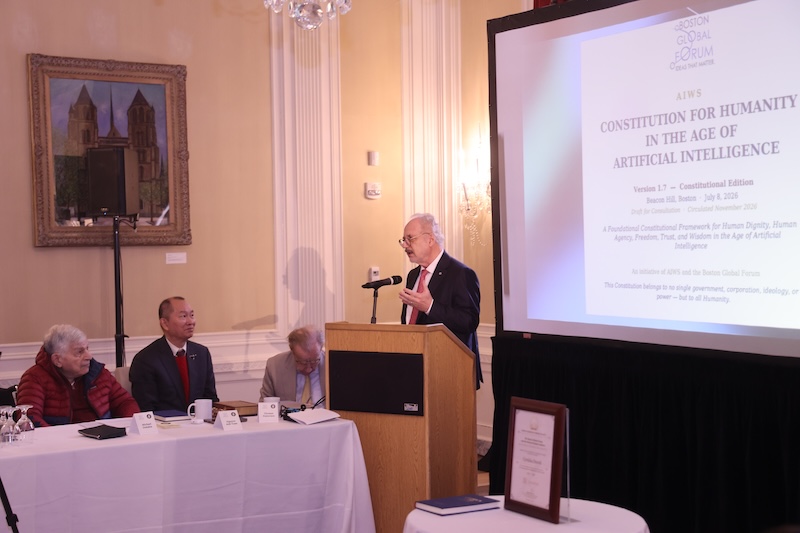
President Egils Levits delivers remarks at the Conference