
World Leader for Peace and Security Award 2026
Summary
Vinton G. Cerf has served as Vice President and Chief Internet Evangelist at Google since 2005. Widely known as one of the “Fathers of the Internet,” he co-designed the TCP/IP protocols and the foundational architecture of the Internet.
Before joining Google, Cerf held senior technology leadership positions at MCI and played a key role in the development of Internet and data networking technologies at the U.S. Defense Advanced Research Projects Agency (DARPA). He served as Chairman of the ICANN Board of Directors from 2000 to 2007 and was the founding president of the Internet Society.
Together with Robert E. Kahn, Cerf has received numerous prestigious honors, including the National Medal of Technology, the Presidential Medal of Freedom—the highest civilian honor awarded by the United States—the ACM A.M. Turing Award, and the Japan Prize.
Cerf is a member of the U.S. National Academy of Engineering, IEEE, ACM, and several other leading scientific organizations. He is also a Distinguished Visiting Scientist at NASA’s Jet Propulsion Laboratory, where he has been involved in research on an interplanetary Internet.
Cerf holds a B.S. in Mathematics from Stanford University and M.S. and Ph.D. degrees in Computer Science from UCLA. He has also received numerous honorary doctorates from universities around the world.
Jason Carter, Chairman of The Carter Center Board of Trustees and grandson of President Jimmy Carter, will receive the award representing the moral leadership legacy of the United States through President Jimmy Carter. President Carter’s lifetime of service — advancing health and human rights, brokering peace, combating disease, and defending democracy around the world — remains one of the most powerful expressions of American moral leadership.
Jason Carter will deliver special remarks titled “America as a Moral Beacon: Continuing the Carter Legacy of Peace, Human Rights, and Trusted Innovation in the Age of AI.”
VINTON G.CERF AND JASON CARTER HONOURED WITH WORLD LEADER FOR PEACE AND SECURITY AWARD
Award announcement
Jason Carter and Vint Cerf to Receive the Award as Symbolic Representatives at the America at 250 Conference, Harvard University Loeb House, May 1, 2026
Boston, Mass., March 25, 2026 — The Boston Global Forum (BGF) today announced the presentation of the 2026 World Leader for Peace and Security Award, honoring the leaders of the United States and the American people on the occasion of America’s 250th anniversary. The award will be presented at the America at 250: A Beacon for the AI Age Conference on Friday, May 1, 2026, at Harvard University Loeb House in Cambridge, Massachusetts.
The 2026 World Leader for Peace and Security Award recognizes America’s historic and enduring contributions to peace, security, democratic values, and human progress. On the occasion of the 250th anniversary of the United States, the Boston Global Forum honors not only the nation’s leaders, but also the spirit, creativity, and civic courage of the American people — whose contributions to science, culture, innovation, and democratic life have helped shape the modern world.
The Award Recipients
The award will be received by two distinguished symbolic representatives.
Jason Carter, Chairman of The Carter Center Board of Trustees and grandson of President Jimmy Carter, will receive the award representing the moral leadership legacy of the United States through President Jimmy Carter. President Carter’s lifetime of service — advancing health and human rights, brokering peace, combating disease, and defending democracy around the world — remains one of the most powerful expressions of American moral leadership. Jason Carter will deliver special remarks titled “America as a Moral Beacon: Continuing the Carter Legacy of Peace, Human Rights, and Trusted Innovation in the Age of AI.”
Vint Cerf, widely recognized as one of the “fathers of the internet,” will receive the award representing the creativity, innovation, and civic spirit of the American people in the digital age. As co-designer of the TCP/IP protocols that form the foundation of the internet, Cerf helped create the global network that transformed human communication, commerce, knowledge, and civic life. He will speak on “Building Information Trust Infrastructure for Democracy in the AI Age.”
“America’s greatest contributions to the world have never been its power alone — but its ideals: liberty, democracy, and the belief that human beings, given the right conditions, can build a more just and peaceful world. At 250, those ideals are more needed than ever.” — Governor Michael S. Dukakis, Co-Author, America at 250: A Beacon for the AI Age
The conference will also feature the presentation of the book America at 250: A Beacon for the AI Age, co-authored by Governor Michael S. Dukakis and Nguyen Anh Tuan, together with high-level discussions on building Trust Infrastructure and a new Trust Order in the AI Age.
About the World Leader for Peace and Security Award
Founded in 2015, the World Leader for Peace and Security Award is presented annually by the Boston Global Forum to honor heads of state, heads of government, and leaders of international organizations whose leadership has made significant contributions to peace, security, and democratic values on the world stage. Past recipients have included Prime Minister Shinzo Abe, UN Secretary-General Ban Ki-moon, President Sauli Niinistö, President Ursula von der Leyen, and President Emmanuel Macron. The 2026 award marks a historic occasion: honoring the United States of America on the 250th anniversary of its founding.
About the Boston Global Forum
The Boston Global Forum (BGF) is a leading think tank dedicated to advancing democratic values, trusted innovation, and global governance in the AI Age. BGF founded the AI World Society (AIWS) and convenes world leaders, scholars, innovators, and policymakers to develop frameworks for peace, security, democracy, and human-centered progress.
Speech Honoring the Leaders of the United States and the American People
May 1, 2026, Harvard University Loeb House
Distinguished guests, honored leaders, dear friends, and members of the Boston Global Forum family,
Today, we—Governor Michael S. Dukakis, Nguyen Anh Tuan, and Professor Thomas E. Patterson, co-founders of the Boston Global Forum—have the profound honor of presenting the World Leader for Peace and Security Award to the Leaders of the United States and the American People.
We do so at a truly historic moment.
As America marks its 250th anniversary, we gather not only to celebrate the enduring journey of the United States, but also to honor a nation and a people whose contributions have helped shape the cause of liberty, democratic governance, peace, security, and human progress across generations.
For 250 years, the United States of America has stood as more than a nation. It has stood as a great and enduring idea: that human beings are born with dignity, that liberty is the right of all, that government must answer to the people, and that peace and security are strongest when rooted in justice, law, responsibility, and moral courage.
The American journey has never been simple. It has known hardship and hope, conflict and reconciliation, sacrifice and renewal. Yet again and again, the United States has shown an extraordinary capacity to rise, to renew itself, and to move forward with courage and purpose.
That is why this occasion carries such deep meaning.
Today, we honor the leaders of the United States, across generations, for bearing the heavy responsibilities of leadership in times of trial and transformation—for helping protect constitutional order, safeguard peace and security, and uphold principles that have inspired people far beyond America’s shores.
And we honor the American people, because the deepest strength of the United States has always lived in them: in their courage, their resilience, their creativity, their generosity, their civic spirit, and their determination to renew the promise of democracy for every generation.
America at 250 is not only the story of presidents, institutions, and historic documents. It is also the story of citizens and communities, of workers and teachers, of soldiers and scientists, of immigrants and dreamers, of families who built, defended, and renewed a nation that continues to inspire the world.
Today, this tribute has even greater significance because humanity is entering a new era—the AI Age.
In this age, peace and security must be understood more broadly and more deeply. They require not only national strength and strategic vision, but also the protection of human dignity, the integrity of information, the resilience of democratic institutions, and the responsible governance of artificial intelligence.
This is why America’s role remains so vital.
With its traditions of constitutional liberty, open inquiry, innovation, academic excellence, and democratic debate, the United States has a unique responsibility to help shape a future in which technology serves humanity, strengthens democracy, and advances civilization with wisdom and moral purpose.
At the Boston Global Forum, we have sought to contribute to that mission through initiatives such as AI World Society, The Social Contract for the AI Age, AIWS Government 24/7, and Trust Infrastructure for Democracy in the AI Age. These efforts are guided by a simple conviction: that in the AI Age, progress must be guided by ethics, freedom must be strengthened by trust, and intelligence must be elevated by humanity.
So today, as we honor the Leaders of the United States and the American People, we do so not only in recognition of the past, but also in hope for the future.
We honor America for what it has contributed to peace, security, liberty, democratic renewal, and the advancement of civilization.
And we look to America’s next chapter with confidence and hope—that it will continue to be a beacon of freedom, responsibility, innovation, trust, and humanity for the AI Age.
It is therefore with deep respect, admiration, and gratitude that we present the World Leader for Peace and Security Award to the Leaders of the United States and the American People.
May America continue to shine as a beacon for peace, security, liberty, and human dignity.
God bless America, and thank you.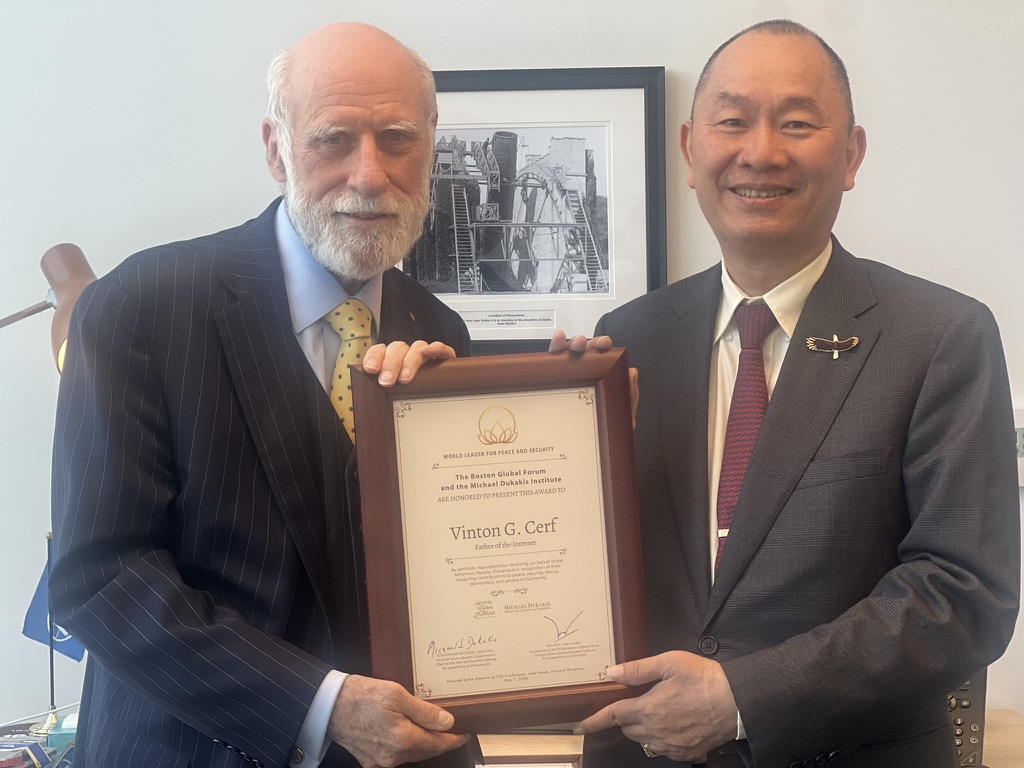
Acceptance Message
Vint Cerf’s Acceptance Speech: Building Information Trust Infrastructure for the AI Age
At the America at 250: A Beacon for the AI Age Conference, held on May 1, 2026, at Harvard University’s Loeb House, Vint Cerf accepted the 2026 World Leader for Peace and Security Award as the symbolic representative of the American people. The award honored the leaders of the United States and the American people for their enduring contributions to peace, security, innovation, democratic values, and human progress.
Widely known as one of the “Fathers of the Internet” and co-designer of the TCP/IP protocols, Vint Cerf represented the creativity, openness, civic spirit, and technological imagination of America in the digital age. His remarks, titled “Building Information Trust Infrastructure for Democracy in the AI Age,” connected America’s 250-year legacy with one of the most urgent challenges of the future: how to build trusted information systems in a world transformed by artificial intelligence.
Cerf’s message carried special meaning for the Boston Global Forum and AI World Society. Having previously been honored by BGF in 2019 as a World Leader in AIWS, he has long embodied the principle that technology must serve humanity with responsibility, openness, and wisdom.
His acceptance speech reinforced a central theme of the conference and the book America at 250: A Beacon for the AI Age: America’s leadership in the AI Age must be measured not only by innovation, but by its capacity to build trust, defend truth, protect human dignity, and strengthen democratic society
Vint Cerf’s remarks helped elevate the May 1 conference from a celebration of America’s past into a call for action: to build AIWS Information Trust Infrastructure as a foundation for peace, security, and a more trustworthy civilization in the AI Age.
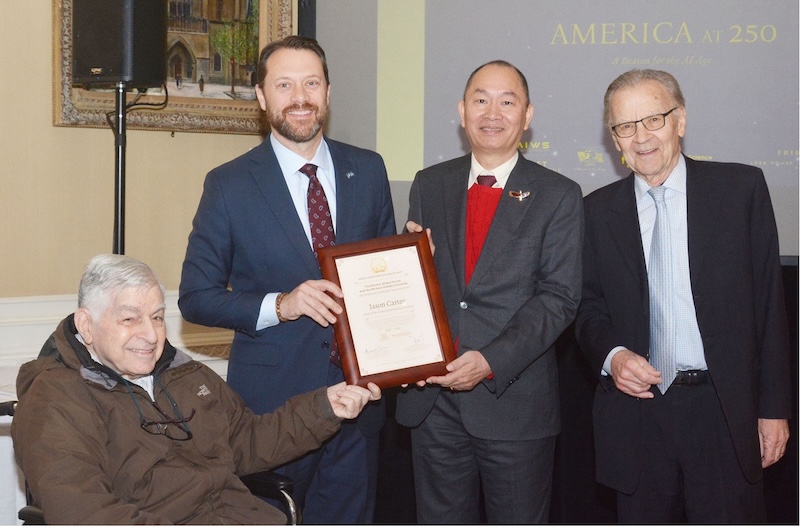
Acceptance Address Accepting the 2026 World Leader for Peace and Security Award on behalf of The Carter Center and the legacy of President Jimmy Carter
Thank you very much. It is a great honor for me to be here today — to celebrate this moment in our country’s history, and to do so on behalf of my grandparents’ legacy and the people of the Carter Center, and the work we have done together.
Let me begin, of course, by saying thank you to Tuan, to Professor Patterson, to Governor Dukakis, and to the other remarkable leaders here who are going to define the next century of thought as we change, dramatically, the way we interact with each other and with the world.
I thought I would reflect for just a moment on my grandfather, Jimmy Carter, who lived for one hundred of these 250 years of American history. The remarkable story of his life — and what he did with technology — is, I think, indicative of how the American people, and the people of the world, will confront this next era.
…….
He was born, frankly, into a technological environment that wasn’t that different from the first 150 years of American history. Professor Pentland can describe these in much more detail than I can, in his book. But my grandfather was born in rural Georgia, in a 600-person village essentially no running water, no electricity, people still living off the land. He plowed fields behind a mule.
Over the course of his hundred years, he observed each step. Rural electrification. Indoor plumbing being installed in his own house — they took down the bucket that had served as a shower and put in actual indoor plumbing. He went on to the Naval Academy and observed the birth of nuclear power, participated in those first engines that ran our submarines. And he did something my children will almost certainly never do: he crossed the ocean in a ship.
Think about the way he watched these things transform — and the way he kept his values, the values he understood to be America’s values first. That national mission statement, now 250 years old: the idea that each person is endowed by their Creator with these inalienable rights. That idea of America carried him through all of those technological changes.· ·
On his 99th birthday, we made a social media birthday card for him — a digital mosaic. I went down to Plains, and I said,
“Papa, this mosaic was created from all of the well-wishes you received from around the world.
” And he said,
“Well — from whom?”
I said,
“Papa, there were tens of thousands of them. They were from over a hundred countries.”
This was 99 years into his life. I had been worried that he wasn’t still having experiences that felt meaningful to him. He looked up at me and said,
“A hundred countries?” I said,
“Yes.” And he teared up.
Think about this person — from a 600-person village — who had seen this world transformed, and had maintained his relationship with that world in a way that was true to him, and true to those values we are talking about today. To be able to experience that, in that moment, was remarkable.
That 99th birthday was about eight months after ChatGPT first launched. So my grandfather lived, literally, from the dawn of electricity in his community to the dawn of AI in our communities.
What he chose to do with the last fifty years of his life — and the reason I feel good about being here and accepting this award — is because the work they did at the Carter Center, and that we continue to do, I think, is helpful here. Let me say two things about AI at the Carter Center.
Some of you may know that the Carter Center has democracy programs and health programs, peace programs and health programs, across the world. We have 3,500 employees who have worked, essentially, beyond the end of the road. Our health programs have addressed neglected tropical diseases in South Sudan. In Chad, we have nearly 1,200 employees — we are the largest employer in Chad. This is a group that knows where Chad is, but most people I talk to do not. It is in sub-Saharan Africa, in the Sahel.The point is that we have done work in places that my grandparents recognized. When they walked, for example, into a 600-person village in Mali and saw guinea worm disease — a disease they knew was preventable and eradicable, but only through the work of people in 600-person villages beyond the end of the road — they recognized that community. They recognized it because that’s where they were from. These are not just places to send pity. They are places where we can recognize their power.
The big difference today, in those communities where the Carter Center has worked, is this. We have eradicated diseases. We have fought a variety of health problems alongside, for example, 35,000 community health workers in Uganda. In Ethiopia, every year, we treat 12 million people in a single week through mass drug administrations for trachoma in the northwest of the country — something you could not do in Massachusetts, or in Georgia where I live. Dr. Rochelle Walensky, our board member who used to run the CDC, can attest to some of that.
……
But what you can do today that is different is this. Every single person born today in those communities — a 600-person village in Mali — is going to skip so much of the technological change that my grandfather witnessed in his lifetime.
When I was in the Peace Corps in South Africa, I had never had a cell phone before. I stood there and realized that, while people were carrying their water from the river and building their houses out of sticks and mud in the place I lived, there would never be a phone line. And now, when we go to the places where we work, we use AI daily in our health programs.
It has transformed the way we detect trachoma — which is a rare disease, and as it becomes rarer, it grows more difficult to detect. But because people have cell phones in northwest Ethiopia, we have the ability to take a picture and use AI to determine, at a remote location, whether or not we have identified trachoma. It transforms our epidemiological work. It transforms a host of other things we do.
And this technology will now be delivered differently. No longer will people who live beyond the end of the road have to sit and wait to acquire this knowledge — or be cut out from it. So long as they have a sufficient data pipe, and a way to interact with it, they will be able to engage with vast stores of human knowledge almost immediately. The transformation in these communities is going to be quick.
It is going to be fast. It is going to be a remarkable explosion of human creativity and access to knowledge — in places we sometimes forget about. But these are the places where the Carter Center works. We must make sure there is trust. We must make sure AI remains human-centered. We must, as my grandfather did, adjust to changing technologies without losing track of our values. This is crucial.
……..
I will conclude with one use of AI as, I hope, a beacon. The Carter Center, in its conflict resolution work, collected — from social media reports of bombings in Syria, on a real-time basis — a vast amount of information. During the Syrian conflict, the Carter Center became the most trusted mapping source for where conflict was occurring. We did that by keeping the same village-centered approach: listening to what was happening on social media, vetting those reports, and then displaying on a map exactly where we understood conflict to be occurring.
What that has allowed us to do now — particularly with the help of AI, which lets us go back in time and crawl through this vast body of data — is that we now have the greatest source of information about where to look and deal with unexploded ordnance. We believe there are some 300,000 pieces of unexploded ordnance in Syria. As that country comes back together in this post-conflict moment, everyone can agree that this is a project they can do together. No matter what side of the war they were on, no matter their political beliefs, they understand there is a human project in that community: to tackle the issue of unexploded ordnance, because it is a threat to children, a threat to every bit of community life, a threat to business — a threat to everything.
Because we have trusted data, we are able to say: we can play a role with you, providing the tools you need to bring people together in peace, to begin sewing this community back together.
It is something we recognize — and the goals of this organization are real. As we talk about the
American people and the idea of America, I just want to make sure that yes, we celebrate my grandparents and the remarkable work of the Carter Center, but also that we recognize the power we have, in the nonprofit world and in other places, to bring people together with this new power — as long as we do it in a way that makes good human sense.
……..
We at the Carter Center are honored to receive this award. We thank everyone here so much. And I accept it on behalf of the American people — with all the power vested in me by no one — and on behalf of the Boston Global Forum. Thank you very, very much. We are deeply honored.
JASON CARTER
Chairman of the Board, The Carter Center
Award Ceremony Video