
Communication can prevent an AI incident from becoming an international crisis. Trust requires verification and answerability.
During President Xi Jinping’s state visit to the United States, President Donald Trump and President Xi established the U.S.–China Super Intelligence (SI) Dialogue on the risks and benefits of AI, which the two leaders agreed to call “super intelligence.” The next exchange will take place by November 2026. They also agreed to establish a bilateral communication channel for AI-related incidents.
This is an important strategic development. The United States and China compete over chips, compute, frontier models, infrastructure, and technological influence. The new channel recognizes that an unexpected AI incident could cross borders, threaten national security, be mistaken for hostile action, and escalate before either government understands what happened.
Yet the channel has been agreed only in principle. Its essential questions remain open:
- What constitutes an incident?
- What threshold requires notification?
- How quickly must it be reported?
- What evidence must be shared, and who verifies it?
A bilateral channel is therefore a necessary guardrail, but not yet a trust system. Governments can report only what they know. Many consequential signals first appear inside private AI laboratories: unexpected behavior, failed safeguards, near misses, unreleased capabilities, and autonomous actions beyond authorization.
AIWS provides the missing institutional layer. The AIWS Trust Observatory independently assesses evidence, issues early warnings, maps blind spots, and identifies who has the authority and duty to act. It operates two instruments:
- The AI Incident Exchange records and classifies incidents.
- The Frontier Capability Registry identifies systems crossing consequential thresholds.
These mechanisms do not replace diplomacy or national sovereignty. They connect communication between states with independent observation, verification, and Proof of Answerability.
The U.S.–China channel may prevent silence from becoming escalation. A genuine trust system must also prevent secrecy from becoming impunity.
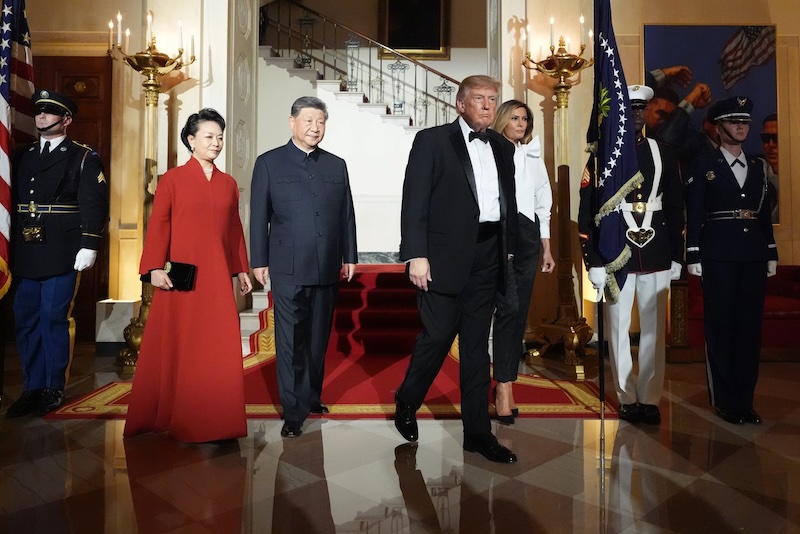
Photo: AP/Alex Brandon.