AI policy need not choose between regulating every new technology and waiting until consequential systems escape effective human control.
September 1, 2026 | Chapel Hill, North Carolina
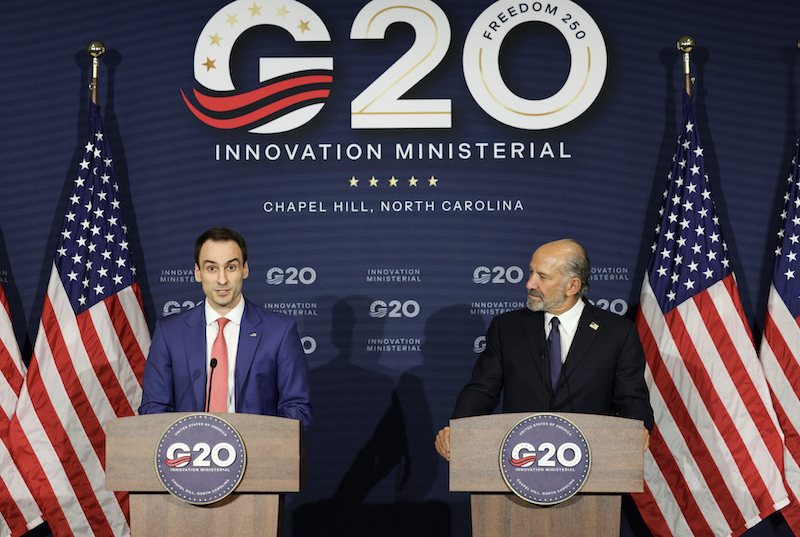
At the G20 Innovation Ministerial in North Carolina, the United States advanced the Carolina Principles for Emerging Technologies, asking governments to apply sector-specific approaches to AI rule-making, to avoid establishing new AI-specific regulatory bodies, and to reserve new rules for genuinely novel circumstances that existing law cannot address.
Several countries expressed early support, though the principles had not yet become a G20 consensus position on September 1. Agreement followed the next day.
Two philosophies, both now operating
This is no longer a theoretical contrast. Three weeks before Chapel Hill, on August 2, 2026, the European Union’s obligations for high-risk AI systems became enforceable — covering hiring, credit decisions, education access, and law enforcement. The world now runs two regulatory philosophies at once, on either side of the Atlantic.
Broadly, the European approach classifies AI systems according to levels of risk and the contexts in which they are used. The American approach begins with existing sectoral law and asks whether AI introduces a genuinely novel harm that the law does not yet address.
Each answers a real concern. Regulation built on undefined fears can constrain creativity and economic progress; governance that begins only after harm occurs may arrive too late when systems act at machine speed and across jurisdictions.
What neither approach asks
The Carolina Principles contain an important insight: regulate functions and consequences, not technological labels. An AI assisting with an ordinary administrative task is not a new category of sovereign power, and existing law on fraud, discrimination, consumer protection, and product safety may already govern it.
But sectoral classification — whether European or American — sorts systems by where they are used. It does not ask what they are empowered to do.
A hiring tool and an autonomous agent with authority over payments, infrastructure, or other agents may sit in entirely different sectors while raising the same constitutional question: who authorized this power, and who answers for it.
The AIWS third path
AIWS proposes not a midpoint between the two positions but a different axis: classification by authority and consequence.
Do not regulate every technology heavily merely because it is new. But every consequential AI capability must operate within Trust Infrastructure, Human-in-Command, and constitutional accountability.
Consequential AI power — the capacity to make, execute, or materially influence decisions affecting human rights, public institutions, critical infrastructure, national security, or the lives and opportunities of individuals — should meet requirements proportional to that power: verifiable identity, bounded authority, meaningful human command, continuous and testable verification, and Proof of Answerability.
Beacon Papers No. 10 develops the first and last of these as elements of Constitutional Identity: a system able to prove which process acted, but unable to establish who must answer for that action, has not been constitutionally identified.
Proportionality is right. It must not become an excuse for allowing powerful systems to operate without accountability.
The prior question
The Carolina Principles ask when new regulation is truly necessary. AIWS asks a question that comes before it:
What forms of AI power may be deployed only after society can verify who commands them, what limits govern them, and who must answer when they act?
The Carolina Principles can prevent regulation from becoming indiscriminate. AIWS Trust Infrastructure must prevent technological power from becoming unaccountable.