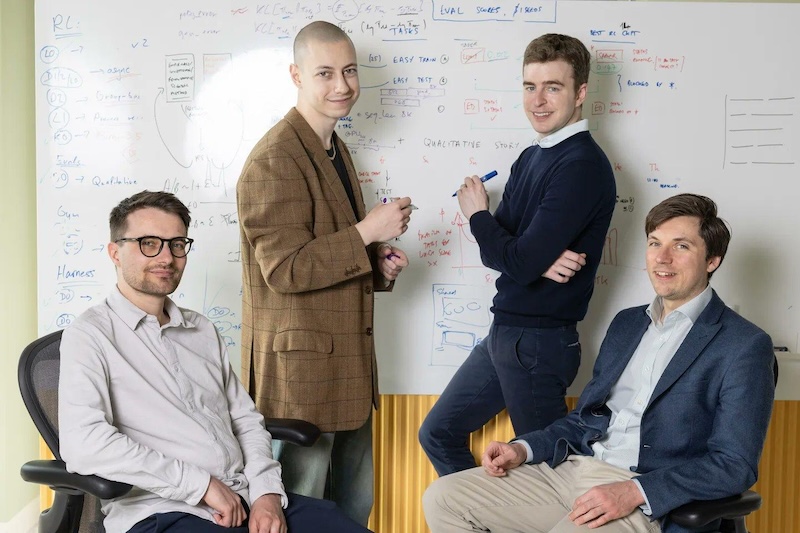
Astra advances the frontier of knowledge. Faraday strengthens its foundations
August 2026 may be remembered as the month AI moved beyond assisting scientists and began participating in science itself.
Astra
On 1 August, OpenAI reported that an internal version of its Astra model produced ten results on problems open for a decade or more — among them the first explicit construction of a non-sofic group, unresolved since Gromov posed the question in 1999. Compute cost for all ten: about two thousand dollars.
The decisive detail is not the mathematics. Every argument was formalised as a Lean 4 certificate and published openly. Lean’s kernel accepts a proof or rejects it. Verification needs no doctorate and no peer-review queue — only a laptop.
For the first time, a claim of AI discovery arrived with the means of checking it attached.
Faraday
Thirteen days later, London-based Inherent introduced Faraday, a 27-billion-parameter “AI Scientist” trained to reproduce published findings. Its Replica framework holds 310 tasks from 100 papers across natural-language processing, materials science and weather forecasting: reproduce a figure without seeing it, under limited time and compute. Inherent reports Faraday surpassing Claude Opus 4.8 and GPT-5.5 on held-out tasks.
The architecture matters more than the score. Faraday is a small model directing a much larger coding agent — GPT-5.5 Codex — as a tool. Judgment sits in the smaller system; capability in the larger one.
A layer of judgment above a layer of capability. That is the shape of Human–AI Co-Creation, arrived at independently and for practical reasons.
What capability cannot answer
Neither result settles what follows. Who chooses the questions science pursues? Who is accountable for an AI-generated finding? How is credit assigned? In June the Leiden Declaration, endorsed by the International Mathematical Union, warned that AI companies use published research without consent and bypass peer review. The community with most to gain has already stated its conditions.
What is not yet verified
- Astra’s results carry Lean certificates anyone can compile. None has completed journal peer review, and Lean does not confirm that a formalisation captures the intended mathematical claim;
- Replica is Inherent’s own benchmark, and the comparisons have not been independently rerun.
Both results are significant. Neither is settled.
Science in AIWS Civilization
Beacon Papers No. 8 presents the world’s first comprehensive architecture for human civilization in the Age of Artificial Intelligence. It holds that three authorities do not transfer to machines: choosing the question, judging meaning, and responsibility for how knowledge is used. It also requires verifiable trust — and a Lean certificate published on the day of announcement is that principle already at work.
- Human beings choose the purposes;
- AI expands the possibilities;
- Transparent verification protects truth;
- Humanity assumes responsibility for the consequences.
It has begun — and without agreed rules for authorship, accountability or credit. That is the work in front of us.
AI advances. Humanity must advance further.
Read and download Beacon Papers No. 8, The Architecture of the Civilization of Human–AI Co-Creation.
Sources: OpenAI’s Astra mathematics report and Lean 4 certificates, 1 August 2026; Inherent, “Training AI Scientists to Replicate Research,” 14 August 2026, arXiv 2608.13331; the Leiden Declaration, June 2026.