Why do we build so brilliantly for capability, and so poorly for trust?
That question opens Chapter 11 of America at 250: A Beacon for the AI Age, by Nguyen Anh Tuan and Governor Michael S. Dukakis. The answer it reaches is not a failure of intention. Almost everyone building advanced AI wants it to be safe. The failure is one of incentive design.
Markets reward what they can measure and monetize quickly. Much of the work that makes AI trustworthy — safety frameworks, independent verification, Human-in-Command safeguards, accountability tools, information integrity, community governance — creates enormous social value while receiving almost none of the reward. This is not an accident of culture, and it will not be corrected by exhortation. Trust infrastructure is a public good: a published safety standard benefits everyone whether or not they paid for it, and one institution’s use of a shared framework diminishes no one else’s. The harms of its absence, meanwhile, fall on third parties who were never part of the transaction — the individuals a biased system disadvantages, the civic and public institutions that absorb the cost of undetected deception. Rational private actors will therefore underinvest, exactly as they underinvest in basic research and public health.
AI’s speed compounds the problem. In slower industries, reputation partly substitutes for market discipline. In an industry whose cycle runs in months, harms surface only after the system has been updated, replaced, or scaled globally, and responsibility has diffused. The deeper AI enters healthcare, finance, education, justice, government, and national infrastructure, the wider this imbalance grows.
Humanity is investing extraordinary resources in making AI more capable. It is time to build the institution that rewards those who make AI trustworthy — and those who use AI to make society better. That institution is the Contribution Economy, developed in the book as the Economy of Social Contribution.
Trust Is the Missing Multiplier
Trust is usually discussed as an ethical requirement. It is also an economic asset, and the economic case is the stronger one.
Consider healthcare. AI could transform diagnosis, drug discovery, and personalized treatment in ways that would save millions of lives, yet capability alone has not produced adoption. Patients, physicians, hospitals, and regulators must first have justified confidence that these systems are safe, fair, accountable, and worth relying on. Every increment of that confidence converts directly into faster adoption and realized benefit. The same pattern appears across finance, education, government, justice, and international cooperation: trust converts technological possibility into sustainable deployment.
That is the Trust Dividend — the compounding value created when people and institutions have justified confidence in the AI systems on which they increasingly depend. For a business, this changes the arithmetic of AI safety. Verification is not overhead. It is part of the infrastructure through which trusted markets become possible at all.
What Counts as Contribution
The Contribution Economy asks a question broader than conventional employment: what does a person, an enterprise, or an institution contribute to building a better society in the AI Age? Teaching a child, sharing knowledge, building something of genuine value, caring for others, enriching a culture, strengthening a community — these have always been contributions, whether or not any payroll recorded them.
The AI Age adds contributions of particular urgency. A researcher who makes AI safer contributes. An engineer who builds effective Human-in-Command safeguards contributes. A citizen auditor who discovers a consequential AI failure contributes. A journalist who protects information integrity contributes. An educator who teaches people to use AI without surrendering their own judgment contributes. And those who conceive and build AI Trust Infrastructure — verification, accountability, incident reporting, meaningful human control — build the foundation on which an AI civilization can develop safely.
The Contribution Economy exists to make such contributions visible, verifiable, recognized, and rewarded.
AIWS Reward: From Contribution to Value
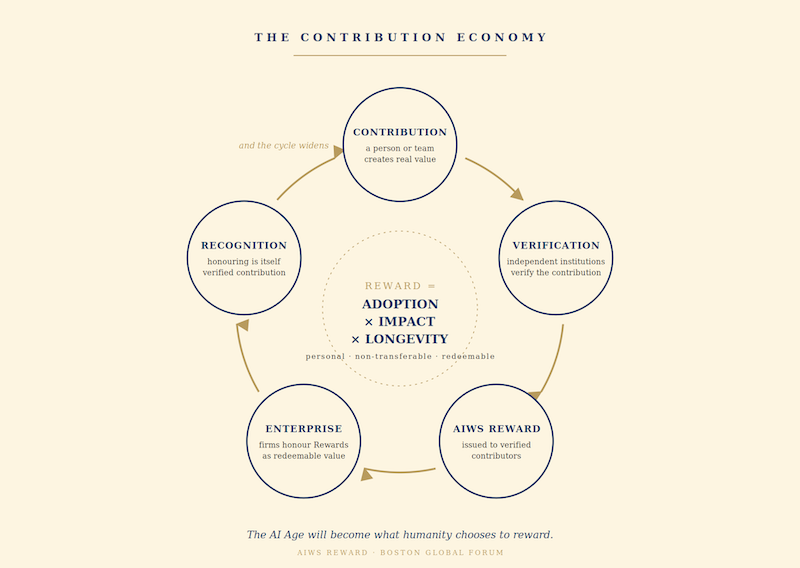
AIWS Reward is the mechanism through which this becomes operational. Its principle is direct: contribution creates value, verified contribution deserves recognition, and exceptional contribution should be rewarded.
Verification comes first. AIWS Reward is never obtained through self-certification. Contributions are assessed independently, through appropriate combinations of technical experts, affected communities, universities, professional bodies, and trusted institutions. A reward available on assertion would not generate the trust it exists to produce.
Impact matters more than assertion. Reward follows a transparent and publicly auditable formula — Reward = Adoption × Impact × Longevity — adjusted for ethical concerns in the contribution itself. A verification toolkit adopted by a hundred hospitals creates more trust value than one adopted by ten, and the reward says so.
Rewards are personal and non-transferable. They cannot be sold, traded, or reassigned. They can be redeemed by their verified recipients for goods, services, opportunities, and benefits voluntarily offered by participating enterprises and institutions. This distinction is what protects integrity while still creating real value: it keeps AIWS Reward from becoming a speculative asset detached from the contribution that produced it.
What Enterprises Can Do Now
Companies do not need to wait for governments. They can begin by honoring AIWS Reward as redeemable value — participating firms in education, healthcare, travel, technology, media, and professional services offering selected goods, services, or opportunities to people whose verified contributions have earned it.
When a company honors an AIWS Reward, it is not making a donation. It is supplying real value to people who strengthened the common foundations on which trustworthy AI and society both depend, and that supply is itself a contribution, recorded at the value honored. The cycle closes: contribution, verification, reward, enterprise support, and further contribution.
The two records differ in kind, and the difference is what makes participation rational. For individuals and teams, AIWS Reward provides recognition and redeemable benefit. For participating companies, their support becomes a verified record of corporate contribution — evidence that the enterprise is helping build a trustworthy AI society, carrying weight in reporting, reputation, procurement, partnerships, and AIWS Trust assessment.
Companies can go further by funding verification capacity they do not control, releasing safety tools as public goods, supporting independent AI research, and reporting their contributions in a form outsiders can examine.
Corporate Responsibility in the AI Age
An economy has two sides. If contribution is recognized, serious harm cannot be treated as economically or morally neutral.
AI companies increasingly hold technologies capable of extraordinary surveillance, information control, behavioral influence, and autonomous decision-making, and with that capability comes responsibility. Such technologies should be supplied only where meaningful safeguards exist: independent oversight, effective legal remedy, disclosure obligations, enforceable limits on power, and mechanisms through which citizens can challenge abuse. The standard should not depend on political labels or lists of countries. It should depend on verifiable institutional conditions, applied consistently — including to a company’s own government.
A commercial contract does not erase responsibility for foreseeable consequences. Companies should not profit from making unaccountable power more powerful. Building healthy and trustworthy AI should become a defining dimension of corporate responsibility in the AI Age.
What Governments Can Do Now
Governments can accelerate the Contribution Economy without controlling it.
They can establish Trust Dividend Funds, combining public resources with private commitments to support verified contributions and early AIWS Reward pilots. They can create tax incentives, grants, fellowships, and procurement advantages for independently verified contributions to AI safety, Trust Infrastructure, education, public health, information integrity, and other public goods. Procurement is the most powerful of these: governments are among the world’s largest purchasers of technology, and making verified contribution part of purchasing decisions would shape what companies build faster than most regulatory mechanisms.
Governments must also accept the standards they ask of others. A state that demands transparency, independent verification, accountability, and Human-in-Command from companies should accept those conditions for its own consequential uses of AI.
And evaluation must never become a government-controlled registry of the social worth of citizens. Verification belongs to independent institutions — universities, professional organizations, civil society, and laboratories such as AIWS Lumina Lab — operating under transparent standards with real opportunity for challenge and review. Government officials may sit on an evaluation council and contribute their judgment, but without decision-making authority, since governments are themselves among the parties whose contributions require assessing. No single institution should monopolize verification: trustworthy evaluation requires institutions capable of checking one another.
From America at 250 to Implementation
The Contribution Economy should now move from idea to implementation. BGF–AIWS can begin AIWS Reward pilots in 2026–2027 with enterprises, research universities, open-source communities, cities, civil society organizations, and governments prepared to move early.
Initial pilots can concentrate where contribution is identifiable and independently verifiable: AI safety and Trust Infrastructure, healthcare, education, information integrity, open science, responsible innovation, and community initiatives demonstrating how AI can improve people’s lives. Healthcare is among the most promising starting points — including AIWS Healthcare initiatives in Vietnam and across ASEAN, where AI in health is urgently needed and where a demonstrated gain in public confidence has immediate human consequences.
The objective is not another awards program. It is the beginning of an economic ecosystem built around contribution.
The Choice Before Us
AI is rapidly increasing the productive and intellectual power available to humanity, while markets and institutions still overwhelmingly reward capability alone. They do not yet adequately reward those who build trust, strengthen human agency, protect society from AI harms, create public goods, or use AI to make civilization better. That is a design problem, and design problems can be changed.
BGF–AIWS calls on governments, enterprises, universities, technology leaders, and civic institutions to begin building the Contribution Economy now — while humanity still has the opportunity to shape this transition rather than respond after disruption has become crisis.
A civilization that rewards capability but not trust should not be surprised when it produces extraordinary capability and insufficient trust. The Contribution Economy proposes another choice: reward those who make AI trustworthy, reward those who use AI to make society better, support those who build the institutions that protect human dignity and human agency, and hold accountable those who use AI to make unaccountable power stronger.
Capability without trust is a weapon without a safety catch. The correction will not arrive through hope; it arrives through design. The AI revolution will not be shaped only by what humanity invents. The AI Age will become what humanity chooses to reward.
Read and download the full THE CONTRIBUTION ECONOMY – It Is Time to Reward Those Who Make AI Trustworthy here: https://bostonglobalforum.org/wp-content/uploads/BGF_Weekly_The_Contribution_Economy-8-8.pdf