
How DeepMind Moved AI from Thinking to Acting
The history of artificial intelligence has long been told as a sequence of intellectual victories. On July 30, 2026, Google DeepMind added a different chapter: Gemini Robotics 2 coordinates the full body of a humanoid robot — balance, arms, hands, and fingers — marking a decisive step in AI’s movement from solving abstract problems to acting in the physical world.
The path is clear. AlphaGo in 2016 showed that a machine could develop strategies no one had programmed, yet it remained confined to a board with fixed rules. AlphaFold in 2020 turned intelligence toward scientific discovery, predicting protein structures of extraordinary complexity — but still only predicted. Gemini, launched in 2023, unified machine intelligence across text, images, audio, and video, and its early robotics models began interpreting open-ended instructions in the real world.
Gemini Robotics 2 completes the crossing. Earlier systems moved arms. This one walks, crouches, balances, reaches, and performs fine manipulation in continuous tasks: retrieving objects, handling tools, tying bags, and unscrewing lightbulbs. What is ordinary for a person requires, for a robot, simultaneous perception, planning, balance, and constant adaptation.
The ambition is ancient. From automata to Karel Čapek’s robot, civilizations have imagined human-made beings that appear to possess agency — and wondered what follows when they do. Those figures are now leaving mythology for laboratories, factories, hospitals, and homes.
The history of AI is no longer only the story of machines becoming better at thinking. It is the story of intelligence acquiring the capacity to act — and the next chapter will be written in the shared physical world, where people and intelligent machines increasingly meet.
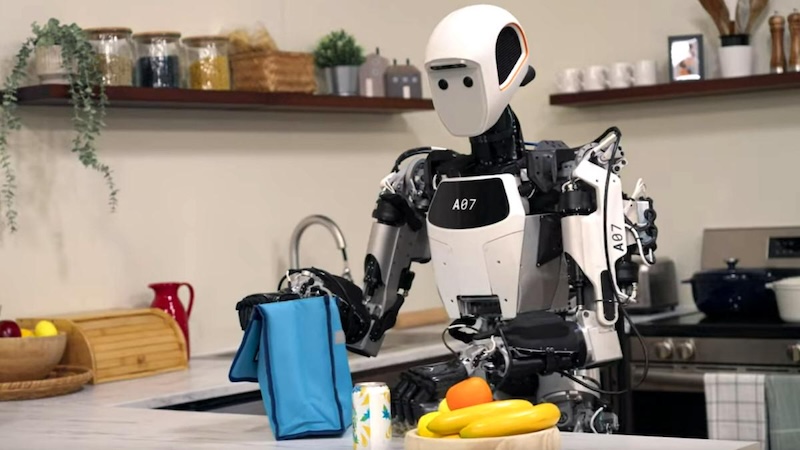
Google DeepMind’s Gemini Robotics brings multimodal intelligence into the physical world, enabling humanoid robots to perceive, reason, and perform dexterous tasks in human environments.