
By Tư Giang
EDITOR’S NOTE
On July 4, 2026 — the 250th anniversary of American independence — the Boston Global Forum and AIWS proclaimed The Boston Declaration: On the Primacy of the Human Person in the Age of Artificial Intelligence. The essay below shows the Declaration entering the public conversation of Vietnam, a nation of one hundred million people pursuing an ambitious national AI agenda under Resolution 57 of the Politburo.
Its author, Hoàng Tư Giang, is one of Vietnam’s leading journalists on economic policy and governance. Writing in VietNamNet, one of the country’s most influential news organizations, he reads the Boston Declaration not as a distant statement from Boston, but as a framework that speaks directly to Vietnam’s own questions — from factory floors and government offices to the future place of human beings in the new civilization. The English translation is provided by the Boston Global Forum.
AI is steadily changing the way people work and make decisions. But as the technology grows ever more intelligent, the most important question is no longer what AI can do — it is what place human beings will hold in the new civilization.
A friend of mine who works in communications tells me that his company no longer hires people to write speeches, draft press releases, or translate and edit English texts the way it once did. AI now does most of that work.
And that is probably only the beginning.
In offices everywhere, AI is quietly slipping into every desk. From writing, translation, customer service, and design to accounting and data analysis, more and more work is being assisted — or partly taken over — by AI. It does not always come as a wave of noisy layoffs. Sometimes a company simply stops hiring.
Walk through Vietnam’s leading automobile plants or many of its garment factories, and you can see robots taking on more and more stages of production: welding car bodies, painting, assembling, cutting fabric, measuring, and inspecting quality. The factories are not yet empty of people, but the role of the human being there has changed.
AI has left the laboratory and entered the workplace, the classroom, the newsroom, the bank, the hospital, the government office — and the phone in every person’s pocket.
For Vietnam, this is a great opportunity. An economy that wants to raise productivity, reform its administrative apparatus, and climb the global value chain cannot stand outside the AI revolution. Resolution 57 of the Politburo has identified science, technology, innovation, and digital transformation as the country’s new engines of development. In that current, AI will be present in nearly every sector of the economy.
But here is where the problem begins: as AI reaches deeper into decisions that directly affect people’s lives, who will stand up and take responsibility when something goes wrong?
An algorithm can recommend rejecting a loan, but it cannot explain to the customer why they were refused. An AI system can help read medical scans, but it cannot replace the physician’s final nod. An AI tool can write an article, but it cannot put its name to the truth — and the errors — of that article. A virtual assistant can help process paperwork, but it cannot sign an administrative decision in place of a public official.
Seen from Vietnam, the warnings of Elon Musk and Geoffrey Hinton no longer feel so distant. Musk believes AI and robots will take over a great many human jobs. Hinton, the “godfather of AI,” worries that the wealth AI creates will concentrate ever more in the hands of those who own the data, the algorithms, and the computing infrastructure, while many people gradually lose the income they once earned from their labor.
Vietnam’s question, therefore, is no longer whether AI will replace human beings. That has already begun. The more pressing concern is what we will do to ensure that workers are not left outside the new game. And the great question is not only: How powerful can AI become? It is: As AI grows ever more powerful, what place will human beings hold in the new civilization?
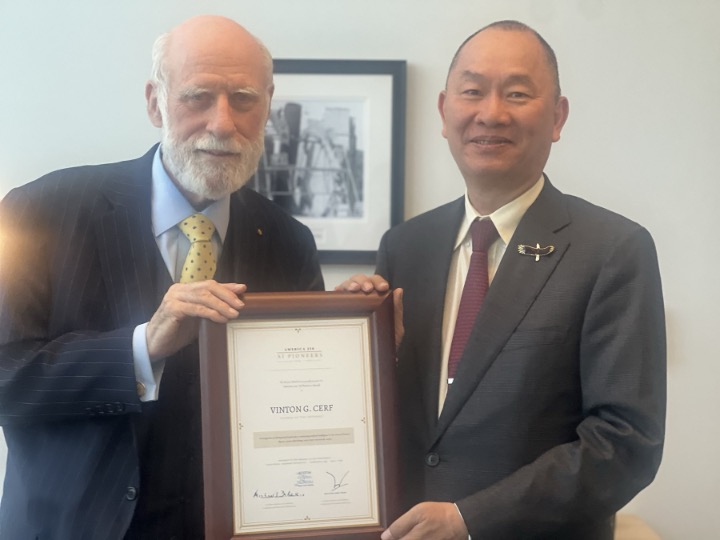
On July 4, 2026 — the very day America marked the 250th anniversary of its Declaration of Independence — the Boston Global Forum and AIWS announced The Boston Declaration: On the Primacy of the Human Person in the Age of Artificial Intelligence. The document makes an assertion that is brief but immensely powerful: “Artificial Intelligence may surpass human intelligence in many domains. It must never surpass the primacy of the human person.”
What is striking is that the Boston Declaration does not call for holding AI back. On the contrary, it recognizes AI as one of humanity’s greatest technological advances — capable of expanding knowledge, improving health care, renewing education, and creating unprecedented opportunities for development. But for precisely that reason, AI must be placed under principles established by human beings, so that technology always serves humanity rather than deciding humanity’s fate.
Among the initiators of the Declaration are Mr. Nguyen Anh Tuan — Co-Founder, Co-Chair, and CEO of the Boston Global Forum, and the founder and former Editor-in-Chief of VietNamNet — and Governor Michael S. Dukakis, the 1988 U.S. presidential nominee.
From the early years of building the Internet in Vietnam to a journey of initiating ideas and initiatives that help lead the conversation on the future of technology and humanity — gathering the world’s foremost leaders and scholars — Nguyen Anh Tuan has wrestled with one question throughout: How can technology serve human beings and help build a better society?
In an essay published on the morning of July 4, he emphasized that the goal is not merely to govern AI, but to help create a civilization in which “intelligence serves wisdom, technology serves humanity, trust strengthens freedom, and innovation advances peace and the flourishing of humankind.”
That is a point where Vietnam would do well to pause and reflect.
If Resolution 57 answers the question of what Vietnam must do to avoid standing outside the AI revolution, the Boston Declaration raises another: What must Vietnam do to ensure that human beings are not diminished within the very revolution it is driving?
A nation strong in AI is not recognized merely by its data centers, its engineering workforce, its large language models, or its technology companies. More importantly, it must be a nation that knows how to build guardrails before the accident happens: How is personal data protected? How transparent must AI be? Do citizens have the right to know when they are interacting with a machine? And which decisions must always have a human being bearing final responsibility?
The Boston Declaration calls this the principle of Human-in-Command — human beings retain command over AI. AI may analyze, forecast, and propose options. But final judgment, moral responsibility, and the right of decision must remain with human beings.
This is not a story that belongs only to Boston or Silicon Valley. For Vietnam, it is a problem already present in every government office, every enterprise, every school, and every newsroom.
In public administration, AI must not become an excuse for officials to evade responsibility. In education, AI must not accustom students to letting machines think for them. In journalism, AI must not turn the making of news into a production line that runs very fast — with no one left standing at the helm to answer for it.
Two hundred and fifty years ago, humanity had to establish that human beings possess rights that cannot be taken away. Two hundred and fifty years later, as human beings themselves create a new form of intelligence, we face a different problem: How can technology grow ever more intelligent while human beings always remain at the center of civilization?
The Boston Declaration sets out ten foundational principles for a trustworthy and humane AI era, affirming that AI must serve human beings, not supplant human values. Human dignity, freedom, creativity, moral responsibility, and the right of self-determination must be the foundation upon which artificial intelligence systems are designed, developed, and governed.
The Boston Declaration bears the names of 17 Founding Signatories — leaders, scholars, and pioneering figures who have helped shape the digital and AI age.
Among them are scientists such as Vinton G. Cerf, one of the “fathers of the Internet”; Yann LeCun, a pioneer of deep learning; Stuart Russell, a leading scholar on AI and on ensuring that AI serves human interests; Judea Pearl, who laid the foundations of causal reasoning in AI; Robert Desimone, a leading scientist of the brain and human intelligence; and Alex Pentland, a pioneer of computational social science and collective intelligence.
Link: https://vietnamnet.vn/khi-ai-ngay-cang-thong-minh-con-nguoi-se-dung-o-dau-2534249.html