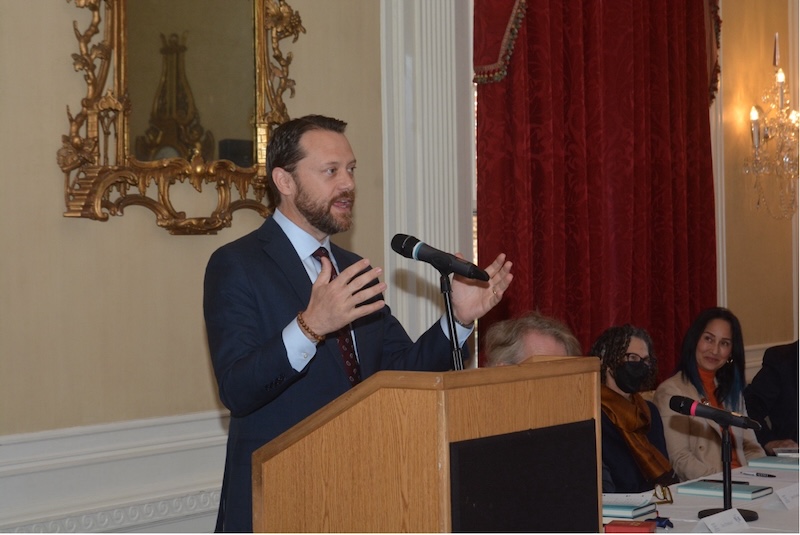
JASON CARTER
Chairman of the Board, The Carter Center
America at 250: A Beacon for the AI Age · Loeb House, Harvard University
Hosted by the Boston Global Forum and the AI World Society · May 1, 2026
Thank you very much. It is a great honor for me to be here today — to celebrate this moment in our country’s history, and to do so on behalf of my grandparents’ legacy and the people of the Carter Center, and the work we have done together.
Let me begin, of course, by saying thank you to Tuan, to Professor Patterson, to Governor Dukakis, and to the other remarkable leaders here who are going to define the next century of thought as we change, dramatically, the way we interact with each other and with the world.
I thought I would reflect for just a moment on my grandfather, Jimmy Carter, who lived for one hundred of these 250 years of American history. The remarkable story of his life — and what he did with technology — is, I think, indicative of how the American people, and the people of the world, will confront this next era.
…….
He was born, frankly, into a technological environment that wasn’t that different from the first 150 years of American history. Professor Pentland can describe these in much more detail than I can, in his book. But my grandfather was born in rural Georgia, in a 600-person village essentially no running water, no electricity, people still living off the land. He plowed fields behind a mule.
Over the course of his hundred years, he observed each step. Rural electrification. Indoor plumbing being installed in his own house — they took down the bucket that had served as a shower and put in actual indoor plumbing. He went on to the Naval Academy and observed the birth of nuclear power, participated in those first engines that ran our submarines. And he did something my children will almost certainly never do: he crossed the ocean in a ship.
Think about the way he watched these things transform — and the way he kept his values, the values he understood to be America’s values first. That national mission statement, now 250 years old: the idea that each person is endowed by their Creator with these inalienable rights. That idea of America carried him through all of those technological changes.· ·
On his 99th birthday, we made a social media birthday card for him — a digital mosaic. I went down to Plains, and I said,
“Papa, this mosaic was created from all of the well-wishes you received from around the world.
” And he said,
“Well — from whom?”
I said,
“Papa, there were tens of thousands of them. They were from over a hundred countries.”
This was 99 years into his life. I had been worried that he wasn’t still having experiences that felt meaningful to him. He looked up at me and said,
“A hundred countries?” I said,
“Yes.” And he teared up.
Think about this person — from a 600-person village — who had seen this world transformed, and had maintained his relationship with that world in a way that was true to him, and true to those values we are talking about today. To be able to experience that, in that moment, was remarkable.
That 99th birthday was about eight months after ChatGPT first launched. So my grandfather lived, literally, from the dawn of electricity in his community to the dawn of AI in our communities.
What he chose to do with the last fifty years of his life — and the reason I feel good about being here and accepting this award — is because the work they did at the Carter Center, and that we continue to do, I think, is helpful here. Let me say two things about AI at the Carter Center.
Some of you may know that the Carter Center has democracy programs and health programs, peace programs and health programs, across the world. We have 3,500 employees who have worked, essentially, beyond the end of the road. Our health programs have addressed neglected tropical diseases in South Sudan. In Chad, we have nearly 1,200 employees — we are the largest employer in Chad. This is a group that knows where Chad is, but most people I talk to do not. It is in sub-Saharan Africa, in the Sahel.The point is that we have done work in places that my grandparents recognized. When they walked, for example, into a 600-person village in Mali and saw guinea worm disease — a disease they knew was preventable and eradicable, but only through the work of people in 600-person villages beyond the end of the road — they recognized that community. They recognized it because that’s where they were from. These are not just places to send pity. They are places where we can recognize their power.
The big difference today, in those communities where the Carter Center has worked, is this. We have eradicated diseases. We have fought a variety of health problems alongside, for example, 35,000 community health workers in Uganda. In Ethiopia, every year, we treat 12 million people in a single week through mass drug administrations for trachoma in the northwest of the country — something you could not do in Massachusetts, or in Georgia where I live. Dr. Rochelle Walensky, our board member who used to run the CDC, can attest to some of that.
……
But what you can do today that is different is this. Every single person born today in those communities — a 600-person village in Mali — is going to skip so much of the technological change that my grandfather witnessed in his lifetime.
When I was in the Peace Corps in South Africa, I had never had a cell phone before. I stood there and realized that, while people were carrying their water from the river and building their houses out of sticks and mud in the place I lived, there would never be a phone line. And now, when we go to the places where we work, we use AI daily in our health programs.
It has transformed the way we detect trachoma — which is a rare disease, and as it becomes rarer, it grows more difficult to detect. But because people have cell phones in northwest Ethiopia, we have the ability to take a picture and use AI to determine, at a remote location, whether or not we have identified trachoma. It transforms our epidemiological work. It transforms a host of other things we do.
And this technology will now be delivered differently. No longer will people who live beyond the end of the road have to sit and wait to acquire this knowledge — or be cut out from it. So long as they have a sufficient data pipe, and a way to interact with it, they will be able to engage with vast stores of human knowledge almost immediately. The transformation in these communities is going to be quick.
It is going to be fast. It is going to be a remarkable explosion of human creativity and access to knowledge — in places we sometimes forget about. But these are the places where the Carter Center works. We must make sure there is trust. We must make sure AI remains human-centered. We must, as my grandfather did, adjust to changing technologies without losing track of our values. This is crucial.
……..
I will conclude with one use of AI as, I hope, a beacon. The Carter Center, in its conflict resolution work, collected — from social media reports of bombings in Syria, on a real-time basis — a vast amount of information. During the Syrian conflict, the Carter Center became the most trusted mapping source for where conflict was occurring. We did that by keeping the same village-centered approach: listening to what was happening on social media, vetting those reports, and then displaying on a map exactly where we understood conflict to be occurring.
What that has allowed us to do now — particularly with the help of AI, which lets us go back in time and crawl through this vast body of data — is that we now have the greatest source of information about where to look and deal with unexploded ordnance. We believe there are some 300,000 pieces of unexploded ordnance in Syria. As that country comes back together in this post-conflict moment, everyone can agree that this is a project they can do together. No matter what side of the war they were on, no matter their political beliefs, they understand there is a human project in that community: to tackle the issue of unexploded ordnance, because it is a threat to children, a threat to every bit of community life, a threat to business — a threat to everything.
Because we have trusted data, we are able to say: we can play a role with you, providing the tools you need to bring people together in peace, to begin sewing this community back together.
It is something we recognize — and the goals of this organization are real. As we talk about the
American people and the idea of America, I just want to make sure that yes, we celebrate my grandparents and the remarkable work of the Carter Center, but also that we recognize the power we have, in the nonprofit world and in other places, to bring people together with this new power — as long as we do it in a way that makes good human sense.
……..
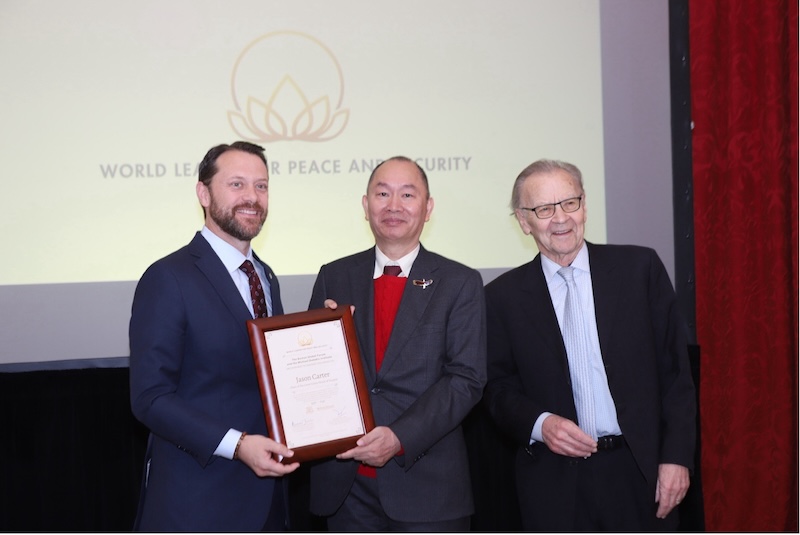
We at the Carter Center are honored to receive this award. We thank everyone here so much. And I accept it on behalf of the American people — with all the power vested in me by no one — and on behalf of the Boston Global Forum. Thank you very, very much. We are deeply honored.
JASON CARTER
Chairman of the Board, The Carter Center