Yasuhide Nakayama
March 15, 2026
- Institutional Standing — A Rare Vietnamese Presence at the Most Distinguished Tables
Nguyen Anh Tuan is one of the rare Vietnamese figures in contemporary history to have earned recognition across three major spheres of influence at once: the American academic establishment, the international multilateral system, and the Vietnamese political system. Few people in the world achieve that — and fewer still do so by building from scratch, without the backing of a powerful family name or the early support of a major institution.
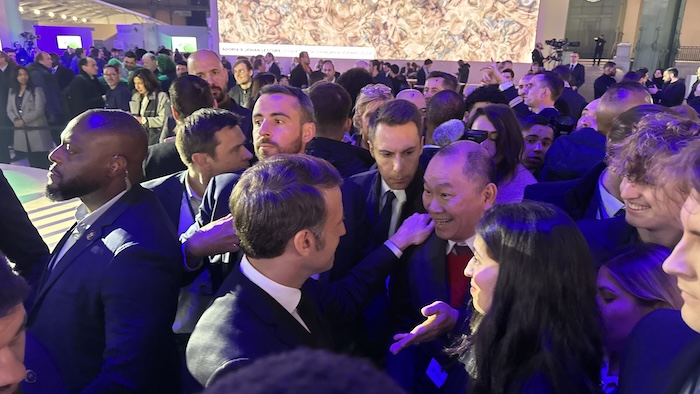
Today, he serves as Co-Founder, Co-Chair, and CEO of the Boston Global Forum; as a Distinguished Member of the Steering Committee of the Wilson Center’s Institute for Strategic Competition, the bipartisan think tank established by the United States Congress; and as co-founder of the Indo-Pacific Spark Initiative alongside Mark Kennedy and the Wilson Center. His footprint extends across the G7 Summits of 2018–2019, multiple engagements with the United Nations, the G20 Summit in India in 2023, the White House Office of Science and Technology in 2024, the AI Action Summit in Paris with President Emmanuel Macron in February 2025, and the America at 250 Conference at Harvard’s Loeb House on May 1, 2026.
Few people in the world earn recognition across three major spheres of influence at once — and fewer still do so by building entirely from scratch.
- The Journey: From Nha Trang to Harvard’s Loeb House
Laying the Foundation — 1990 to 2011
His journey began with two pioneering achievements: founding VietNet, Vietnam’s first TCP/IP-based Internet service provider, and founding VietNamNet in 1997, Vietnam’s first online newspaper. From that starting point, he followed a path few Vietnamese had walked before.
In 1996, at the age of 34, he was honored by the Vietnamese Government as one of the country’s Ten Most Outstanding Young Faces of the Year for his achievement in founding VietNet. This was not recognition for ideas alone; it was recognition for a real infrastructure project, built at a time when Vietnam had barely begun to imagine digital connectivity. From VietNet, he went on to establish VietNamNet in 1997 and served as its Editor-in-Chief until 2011.
Nearly fifteen years shaping Vietnam’s digital media landscape gave him more than experience. It gave him a distinctive understanding of the relationship between information, power, and society — an understanding he would later bring to the architecture of AI governance.
Building a Foundation in America — 2007 to 2012
In 2007, he arrived at Harvard as a Shorenstein Fellow at the Kennedy School, researching trends in the development of electronic media. This was a turning point. From 2008 to 2016, he served on the Harvard Business School Global Advisory Board. He also chaired the International Advisory Committee of the UNESCO–UCLA Chair on Global Citizenship Education. These were not merely honorary affiliations; they were working roles within the American intellectual and policy ecosystem, built through years of sustained engagement.
The Boston Global Forum and the Building of Global Architectures — Since December 12, 2012
On December 12, 2012, together with Governor Michael Dukakis — three-term Governor of Massachusetts and the Democratic Party’s 1988 nominee for President of the United States — and Harvard Professors Thomas Patterson and John Quelch, he co-founded the Boston Global Forum.
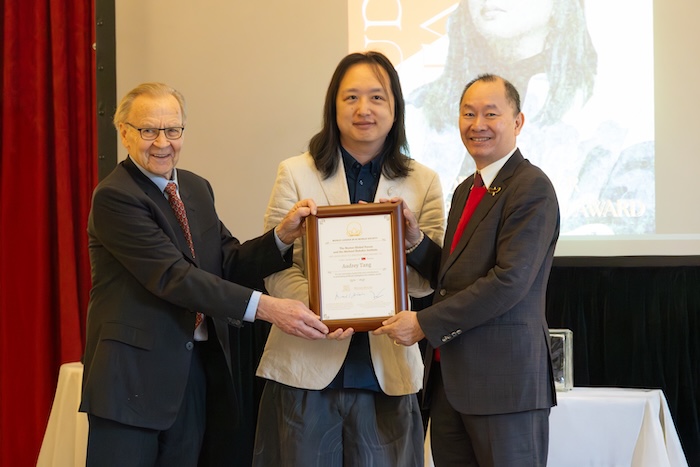
Beginning in 2015, he established the World Leader for Peace and Security Award, an annual honor recognizing Presidents, Prime Ministers, and spiritual leaders for outstanding contributions to global peace. He also founded the World Leader in AI World Society Award, which recognizes pioneers working to build a human-centered AI society. Over more than a decade, these awards have become mechanisms for convening a global community of leaders around the vision of BGF and AIWS.
In 2017, at Governor Dukakis’s own home in Brookline, Massachusetts, the two men laid the foundations of the AI World Society — a political, economic, and social model for ethical, human-centered AI governance. Nguyen Anh Tuan became its chief intellectual architect, developing frameworks that range from the Social Contract for the AI Age in 2020 to AIWS Government 24/7, a model for transparent, accountable, and continuously available democratic governance in the digital era.
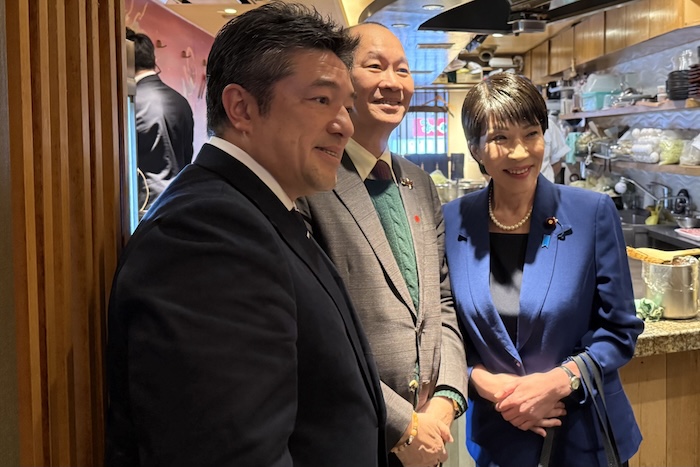
In July 2022, immediately following the assassination of Japanese Prime Minister Shinzo Abe, he founded the Shinzo Abe Initiative for Peace and Security — carrying forward the legacy of a leader who had himself received BGF’s World Leader for Peace and Security Award, while also deepening the strategic relationship between BGF and Japan.
VTV Person of the Year 2018 — At Harvard
In 2018, Vietnam’s national broadcaster VTV named him Person of the Year for the AI World Society initiative, and the award ceremony was held at Harvard University in January 2019.
This event carried deep symbolic significance. For the first time in history, VTV held its Person of the Year ceremony not in Vietnam, but at one of the world’s most prestigious universities — where the honoree was building global influence. It was not merely recognition of an individual. It was a declaration that Vietnam had produced someone sitting at some of the most important tables of the AI Age.
For the first time in history, VTV held its Person of the Year ceremony not in Vietnam, but at one of the world’s most prestigious universities — where the honoree was building global influence.
AI Strategy Roundtable with General Secretary Tô Lâm — London, October 28, 2025
On October 28, 2025, at the historic Raffles Hotel London, Nguyen Anh Tuan served as co-organizer and chief moderator of an event that very few Vietnamese have ever occupied: a High-Level AI Strategy Roundtable bringing together General Secretary Tô Lâm and the senior leadership of Vietnam — including Politburo members, the First Deputy Prime Minister, and the Ministers of Defense, Public Security, Foreign Affairs, Finance, Science and Technology, and Education, as well as the Governor of the State Bank of Vietnam — alongside world-renowned strategists and experts in AI, digital governance, and semiconductor technology.
This was not an ordinary academic conference. It was a strategic consultation at the highest level of the Vietnamese state, convened through the Boston Global Forum’s international network of thinkers and experts — including Professor Alex Pentland (MIT), Professor Thomas Patterson (Harvard), Mark Kennedy (Wilson Center / former U.S. Congressman), Liam Maxwell (AWS; former UK Government Chief Technology Officer), Tantum Collins (former Director for Technology and National Security at the White House), Glen Weyl (Microsoft Research), Lord Francis Maude (former UK Minister for Government Reform), Lord Liam Booth-Smith (Anthropic; former Chief of Staff to Prime Minister Rishi Sunak), Andrew Trask (DeepMind / OpenMined), and many other distinguished experts.
At the event, he presented three comprehensive strategic programs that BGF proposed in support of Vietnam’s AI development:
- AIWS Government 24/7 — a model of continuous, transparent, and trusted AI-powered governance
- The Center for Digital Assets with AIWS Digital Asset Standards (AIWS-DASI) — the world’s first ethical certification system for digital assets
- The AIWS Film Park — a cultural and technological innovation platform combining AI with Vietnamese heritage, positioning places such as Nha Trang, Hạ Long–Yên Tử, and Hội An as global destinations for AI-enhanced creative industries
His dual role in London — as both co-architect of the strategic content and chief moderator of the dialogue between Vietnam’s top leadership and the international community of strategists — stands as one of the clearest demonstrations of his unusual position: a rare figure trusted by both sides, with the standing to bridge both systems and the intellectual architecture to turn high-level dialogue into an actionable strategic roadmap.
A rare figure trusted by both sides, with the standing to bridge both systems and the intellectual architecture to turn high-level dialogue into an actionable strategic roadmap.
- Intellectual Creation — What Sets Him Apart from Mere Connectors
What most distinguishes Nguyen Anh Tuan is not simply the breadth of his network, but the fact that he produces original intellectual frameworks that the American and international systems take seriously.
In January 2025, he received the UNGSII Award at Davos — the World Economic Forum — in recognition of his outstanding contributions to advancing the United Nations Sustainable Development Goals.
In November 2025, CTO Magazine published an in-depth interview titled “Building a Responsible Digital Future: Nguyen Anh Tuan on AI Ethics, Innovation, and Global Leadership.” The interview described him as a figure working to build a responsible digital future and challenging today’s leaders to think beyond efficiency and disruption in order to create technology that uplifts societies, preserves truth, and sustains human values in an increasingly algorithmic world. That a publication devoted to the world’s foremost technology leaders would feature a Vietnamese thinker not for a product launch or a funding round, but for a philosophy of governance, speaks to the reach his ideas have achieved.
In 2021, he served as Editor of Remaking the World — Toward an Age of Global Enlightenment, published by the United Nations and the Boston Global Forum. The Vietnamese edition, published by Tri Thuc Publishing House, was presented by Vietnam’s National Assembly to every delegate — a formal acknowledgment that the book had become reference material at the highest level of the national legislature.
The true weight of that volume lies not only in its vision, but in the stature of those who chose to contribute to it under his editorship. Contributors included:
- Ursula von der Leyen, President of the European Commission
- Ban Ki-moon, Secretary-General of the United Nations
- Shinzo Abe, Prime Minister of Japan
- Vaira Vīķe-Freiberga, former President of Latvia and Chair of the Club de Madrid
- Vint Cerf, father of the Internet
- Judea Pearl, Turing Award recipient
- Alex Pentland, named one of the world’s most influential data scientists
- Stavros Lambrinidis, Ambassador of the European Union to the United States
When figures of that stature choose to appear together in a single volume, they do not do so out of courtesy alone. They do so because they believe the intellectual framework of the book is worthy of their contribution. And the person who brought them together was a Vietnamese man from Nha Trang.
Together with Professor Thomas Patterson — Bradlee Professor of Government and the Press at Harvard Kennedy School, and author of works ranked among the most influential books on public opinion in the last half-century — he co-authored AI World Society: 30 Years of US–Vietnam Partnership, from Nha Trang to Boston, 1995–2025.
Together with Governor Michael Dukakis, he co-authored America at 250: A Beacon for the AI Age — a visionary book on America’s leadership role in the AI Age, presented at the America at 250 Conference at Harvard’s Loeb House on May 1, 2026.
These two books — one with Harvard’s leading scholar of political communication, the other with a former U.S. presidential nominee — are among the clearest evidence of his standing as a genuine peer among highly influential figures, rather than merely a participant in their orbit.
He is doing what many larger organizations have yet to accomplish: defining conceptual frameworks for AI governance at a moment when the world has not yet reached consensus on the matter. In an intellectual marketplace where every major power is searching for a common language, the person who builds the vocabulary and syntax of that debate is the person with real influence — whether or not he holds formal office.
As VietNamNet observed at the close of 2025, he is a rare figure: one whose roots lie in digital journalism, yet who now leads influential international initiatives on AI governance and ethics. He represents the kind of leadership this historical moment demands — not someone who speaks about AI louder or faster than others, but someone who asks the central question: How will AI make society better, and who will be accountable?
The person who builds the vocabulary and syntax of that debate is the person with real influence — whether or not he holds formal office.
Conclusion
From the pioneer of Vietnam’s Internet in 1996, to the architect of AI World Society in 2017, to the co-architect of the AIWS Trusted Order for the America at 250 Conference in 2026, the journey of Nguyen Anh Tuan follows a remarkably consistent line: standing at the intersection of technology, governance, and human values — and doing so with unusual foresight, often seeing what others have not yet fully recognized.