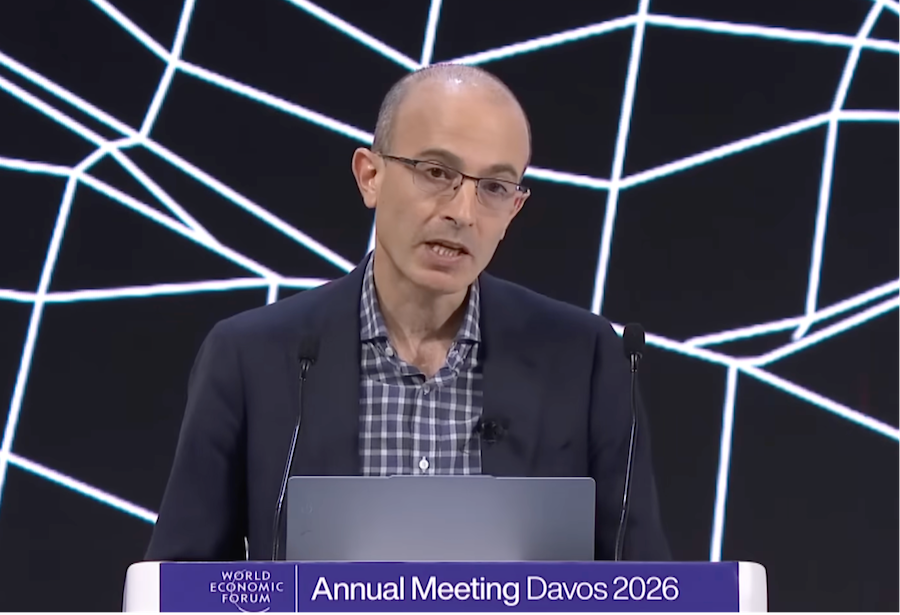
At the World Economic Forum 2026, historian-philosopher Yuval Noah Harari, in conversation with neuroscientist Irene Tracey, warned that generative AI is crossing a threshold: it is no longer merely a tool, but an agent that can generate content, persuade, and deceive at scale—especially in domains where language is power, such as law, religion, politics, education, and finance.
Harari’s central claim is that if AI systems become better than humans at producing narratives and arguments, they can begin to reshape the “operating system” of social life—the shared language that coordinates institutions, trust, and collective decision-making. The discussion raises a provocative governance question: Should AI ever be granted legal personhood? Harari frames this as a high-stakes choice, because personhood could shift accountability away from human actors and institutions.
A major theme is the impact on the next generation: children may grow up interacting more with AI than with other humans, forcing education systems to rethink literacy, critical thinking, and civic resilience in an AI-mediated public sphere.
The session underscores an urgent agenda for democratic societies—strengthening information integrity, ethics, and human-centered governance—before AI-native persuasion becomes the primary interface of public life, a direction that closely aligns with the AI World Society (AIWS) vision.
Please see full here: https://singjupost.com/yuval-noah-hararis-remarks-wef-davos-2026-transcript/