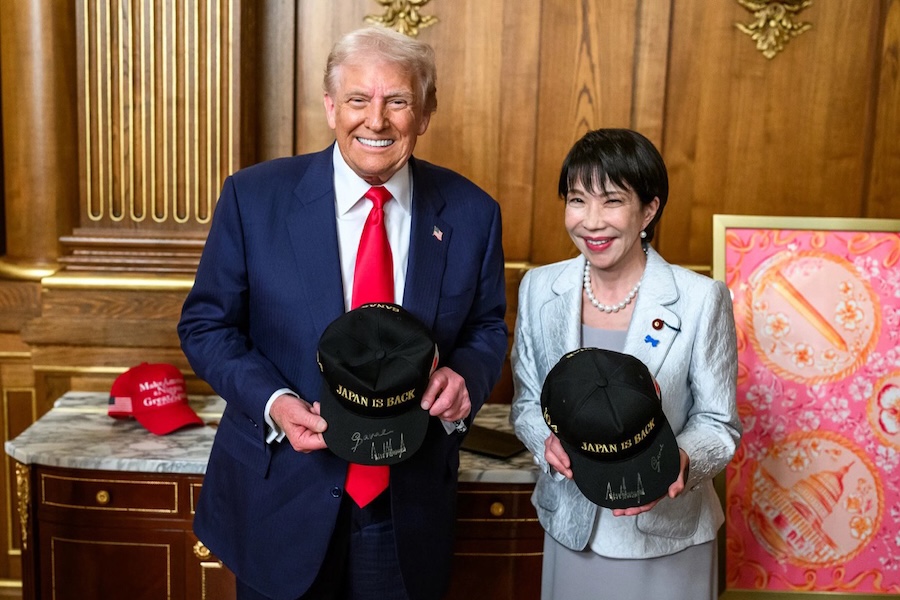
President Trump’s visit to Asia in late October 2025 involved crucial, high-stakes meetings with two of the region’s most important leaders: the newly inaugurated Japanese Prime Minister Sanae Takaichi and Chinese President Xi Jinping.
Strengthening the Japan-U.S. Alliance
The meeting with Prime Minister Takaichi in Tokyo was framed as a success, aiming to usher in a “new golden era” for the U.S.-Japan alliance. Coming only days after Takaichi took office as Japan’s first female prime minister, the summit focused heavily on personal diplomacy, defense, and economic commitments.
- Defense and Security: Takaichi pledged to increase Japan’s defense spending and reaffirmed the importance of peace and stability in the Taiwan Strait. The leaders emphasized cooperation to strengthen the alliance’s deterrence capabilities.
- Economic Cooperation: The talks finalized significant agreements, including up to $550 billion in Japanese investments in U.S. energy and technology projects, marking a win for the U.S. administration on trade.
The High-Stakes Xi-Trump Summit
Following the stop in Japan, President Trump met with President Xi Jinping in Busan, South Korea, on the sidelines of the APEC Summit. This was the first face-to-face meeting between the two leaders since 2019, and its primary focus was stabilizing the tense trade relationship.
- Trade Truce: The leaders reached an agreement that temporarily lowered tariffs on Chinese goods in exchange for China’s commitment to resume large-scale purchases of U.S. farm products (specifically soybeans) and an agreement to resolve restrictions on rare earth minerals.
- Cooperation: The two also discussed cooperation on non-trade issues, including combating fentanyl (with an associated tariff reduction) and working together on global issues like the war in Ukraine.
The back-to-back summits demonstrated a clear U.S. strategy to shore up alliances with partners like Japan while simultaneously engaging the central rival, China, on critical trade and security issues.