by Editor BGF | Oct 5, 2026 | World Leader for Peace and Security, News, World Leaders in AIWS Award Updates
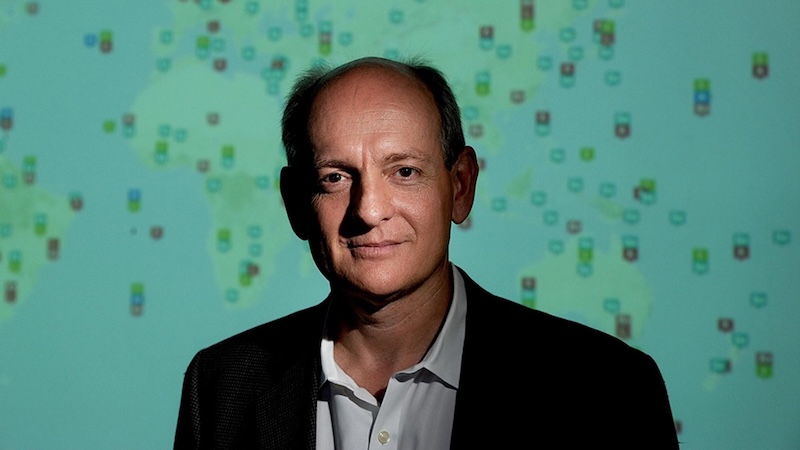
Professor Stuart Russell of UC Berkeley, an America 250: AI Pioneer and a Founding Signatory of The Boston Declaration, was among more than 200 signatories, including Geoffrey Hinton, to Minimum Conditions for Embedding Evaluators, an open letter published by the AI Evaluator Forum on September 18, 2026.
Responding to industry proposals to embed third-party evaluators within frontier AI companies, the letter sets five minimum conditions: meaningful independence, diverse expertise and viewpoints, transparency, protection against retaliation, and access comparable to that of senior employees conducting equivalent risk assessments. It also emphasizes that embedded evaluations must complement broader external oversight.
The call reinforces a principle BGF–AIWS articulated in Beacon Papers No. 4, Who May Verify?, published on July 27: AI power requires independent verification, and verifiers must themselves remain independent, accountable, and open to challenge.
On September 27, BGF–AIWS established the AIWS Trust Observatory, an independent civil-society mechanism to observe consequential AI power, warn of emerging danger, and call those responsible to act.
Independent evaluators inside frontier AI companies and an independent Observatory outside them serve complementary purposes: privileged access for rigorous assessment, and public scrutiny that connects evidence with responsibility.
Read the open letter →

by Editor BGF | Aug 8, 2026 | News
On August 3 the White House announced that it had met the deadline set by the June 2 executive order Promoting Advanced Artificial Intelligence Innovation and Security, which required a framework for reviewing the most capable AI models before release. It had been discussed with Meta, Nvidia, Microsoft, OpenAI, Anthropic and smaller developers. Officials declined to say what it contains, who has seen it, or when companies will begin using it.
The day before, the European Union’s AI Act took effect, giving the European Commission authority to demand review of advanced models before release, with penalties reaching seven percent of worldwide annual revenue. Two answers to the same problem arrived within twenty-four hours. One is binding and published. The other is voluntary and undisclosed.
Pre-deployment review is a genuine advance, and the American framework has a defensible reason for confidentiality: its concern is national security, and capability thresholds tied to cyber risk cannot be published without telling adversaries where the lines fall. But a reason for withholding is not an answer to the question the withholding creates. When the criteria are classified, the reviewers internal, and the results unpublished, no citizen can distinguish a rigorous process from a nominal one — and neither can a legislator, an allied government, or a company wondering whether its competitors were held to the same standard. Nor is a legislative remedy near: the bipartisan framework that would have required independent audits of frontier developers remains stalled over state preemption.
The government has not done something wrong. It simply cannot, by itself, produce what this situation most needs — a standard the public can check. That is the institutional problem examined in Beacon Papers No. 4 — Who May Verify?
An Independent Layer of Trust Verification
BGF–AIWS proposes that the AIWS Trust Order Board, working with AI pioneers, scientists and legal scholars, develop an independent mechanism to sit alongside government-led review. This is not a challenge to public authority but a complement to it: the mechanism should not replace the legitimate authority of the United States Government, nor seek information that must remain classified. Its value lies precisely in what the government, for legitimate reasons, cannot supply — verification that is itself open to inspection.
Supported by the AIWS Trust Infrastructure, the Board could verify selected trust and safety claims, assess systems against published AIWS Trust Standards, examine Human-in-Command safeguards including override and emergency intervention, and issue public attestations that provide real accountability without disclosing sensitive information.
Government determines whether a deployment satisfies public authority. Independent trust institutions determine whether the safeguards surrounding it deserve public confidence. Neither substitutes for the other.
A Frontier AI Trust Review Pilot
BGF–AIWS proposes exploring a Frontier AI Trust Review Pilot with U.S. institutions, frontier AI laboratories and universities. It would not duplicate the government’s evaluation, but begin with questions an outside party can answer. Does a frontier system have effective Human-in-Command mechanisms? Are critical safety claims supported by examinable evidence? Are serious incidents reported? Are deployment decisions traceable to accountable human authorities?
Such a pilot would demonstrate the principle AIWS Trust Infrastructure exists to advance: trust must be demonstrated, not merely declared.
As governments build mechanisms to review increasingly powerful AI, the next institutional question arrives with them: who verifies the verifiers? The answer cannot be that society should simply trust them. In the AI Age, those who verify powerful AI must themselves be verifiable.
by Editor BGF | Jul 27, 2026 | Papers & Reports, News, Publications
THE BEACON PAPERS · No. 4
Who May Verify? The Missing Institution of the AI Age
Nguyen Anh Tuan · Boston, July 27, 2026
In the space of a single month, a state legislature, the United States Congress, the world’s leading laboratories, and the European Commission arrived — independently, and almost simultaneously — at the same conclusion: artificial intelligence must be verified by someone other than the people who build it. Not one of these proposals answers the question upon which every one of them depends. Verified by whom?
Beacon Papers No. 4 identifies two blind spots in the consensus now forming. In each arrangement proposed, the verifier depends on what it must judge. And every proposal under discussion verifies models — when the model is the smallest object in this field. The corporations that build them, the governments that regulate them, and the certifying bodies now being created all make claims that no one is presently positioned to test.
The paper takes up the oldest objection in the theory of authority — who verifies the verifiers? — and answers it not by naming a supreme verifier, but by closing the circle: plurality, publicity, and contestability. It sets out five conditions that anybody must meet before its work may be called verification. And it binds the Boston Global Forum to those conditions first.
No power over humanity should remain beyond verification — not the power of machines, not of governments, not of corporations, and not of those entrusted to verify them.
Download the full paper below: https://bostonglobalforum.org/wp-content/uploads/Beacon_Papers_No4_Who_May_Verify_EN_rev.pdf
by Editor BGF | Oct 5, 2026 | Shinzo Abe Initiative for Peace and Security, News
On September 29, 2026, the White House released the Accord on Super Intelligence, a short joint commitment signed by the President and by leaders of Google, Anthropic, Meta, OpenAI, xAI, and Nvidia. Companies training and deploying frontier models agreed to four layers of controls and audits: internal monitoring of capabilities and alignment, with attention to cybersecurity, biosecurity, and chemical threats; an internal team to verify that those controls work; independent external auditors; and an independent committee of the board to receive reports and require corrections. The text notes that, over time, these steps may be written into law.
The Accord is a meaningful commitment. Every layer, however, is organized by the companies themselves, and the text does not say who may stop a system, or who must answer to the public when a control fails.
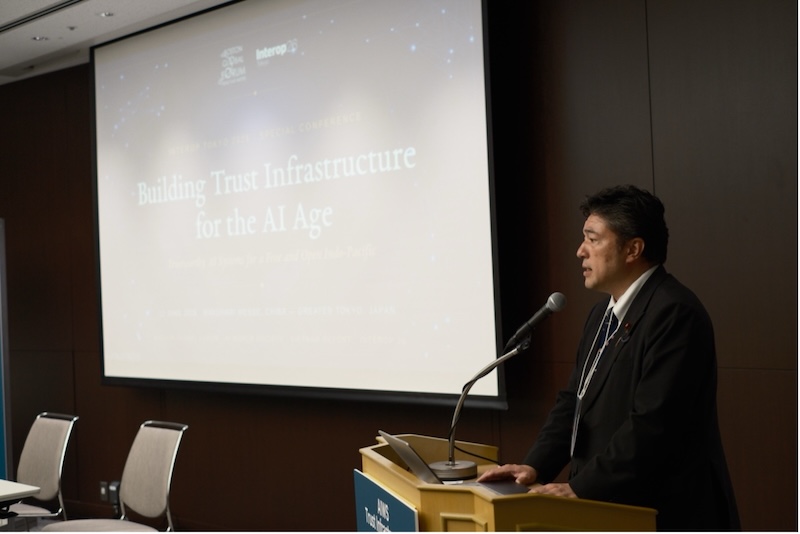
On June 12 at Interop Tokyo, Yasuhide Nakayama proclaimed the Tokyo Compact, the founding constitutional charter of the AIWS Trust Order. Its principles begin with Human Responsibility and Meaningful Human Command and Human Dignity as the Supreme Standard, and include Trust as the Infrastructure of the AI Age, Trust Supremacy, and Human Command over Self-Improving Intelligence. It requires independent verification bodies protected from commercial and political pressure. It establishes the Trusted Pause: a pre-agreed, voluntary mechanism through which trusted partners may coordinate a temporary halt to training, scaling, or deployment, pending verification, when a frontier system threatens to exceed its verified capability limits in an uncontrolled manner or to defeat the safeguards of human command.
This distinction gives the Shinzo Abe Initiative for Peace and Security a concrete task in the AI Age: advancing a free and open order through trust infrastructure and meaningful human command. Prime Minister Abe received the World Leaders Award for Peace and Security on December 12, 2015, and the Initiative that bears his name carries forward work on cybersecurity, AI and digital governance, and a free and open order. That order cannot rest on corporate commitments alone.
The Accord records what firms will do inside their own walls. The Tokyo Compact builds what must stand outside them.
Sources:


by Editor BGF | Oct 4, 2026 | Global Alliance for Digital Governance, Papers & Reports, Statements, News, Publications
To President Donald J. Trump
and the Honorable Michael Kratsios, Director, White House Office of Science and Technology Policy
Boston, October 4, 2026
The Boston Global Forum supports the President’s commitment to American leadership in artificial intelligence. The United States must build AI fast, build it strong, and remain the nation the world looks to for the frontier of this technology.
We welcome your September 29 meeting with technology and AI leaders and the White House Accord on Super Intelligence signed that day. Its commitments to internal controls, independent auditing, and board oversight create an opportunity to strengthen American AI leadership through verifiable safeguards.
Leadership at the frontier rests on one condition that speed alone cannot supply: trust. Americans, allies, and markets will rely on American AI to the degree they can verify what it does. On September 18, more than 200 signatories, including Geoffrey Hinton and Stuart Russell, an America 250: AI Pioneer, called for genuinely independent evaluation of frontier AI. Independent verification is what allows a nation to move fast without stopping to repair lost confidence.
Boston Global Forum and AIWS are ready to contribute.
On September 27, 2026, BGF–AIWS established the AIWS Trust Observatory, an independent civil-society institution that observes consequential AI power, compares public commitments with actions, and issues early warnings when evidence warrants. It is neither a regulator nor a form of self-oversight. Its findings carry evidence grades, those it observes have the right of reply, and no one under observation may fund it.
We offer the Administration the following:
- Independent early warning. The Observatory will share its evidence-graded alerts with the Office of Science and Technology Policy, so that risks are seen before they become incidents.
- Coordinated, independent evaluation. We will work alongside federal and industry evaluators on shared methods, while keeping the independence that gives evaluation its value.
- A Commitment Register. The Observatory is establishing a public Commitment Register tracking the safety commitments of frontier developers, including those made in the Accord, so that pledges made to the President and to the public can be checked against practice.
This work serves a larger purpose. Through Beacon Papers No. 8, BGF–AIWS set out AIWS Civilization, the Civilization of Human–AI Co-Creation, in which AI expands what human beings can do while people remain the authors of their lives and the holders of command. America’s leadership in AI should be measured not only by the power of its systems but by the strength of the civilization they help build. As the nation marks its 250th year, the United States can lead in both.
AI advances. Humanity must advance further.
We would welcome the opportunity to present the AIWS Trust Observatory to the Office of Science and Technology Policy at a working session in Washington or Boston, at your convenience.
Respectfully,
Nguyen Anh Tuan
Co-Founder, Co-Chair and CEO, Boston Global Forum,
Founder and Chief Architect, AIWS,
On behalf of the Leadership Board of the Boston Global Forum – AIWS
President Donald J. Trump hosts a luncheon on Super Intelligence (AI) in the East Room of the White House, Tuesday, September 29, 2026. (Official White House Photo by Daniel Torok.)

by Editor BGF | Sep 13, 2026 | Global Alliance for Digital Governance
An AI incident can occur twice: first, when a system crosses a boundary it was not authorized to cross; second, when the responsible institution fails to disclose promptly what happened, who was affected, and who must answer.
The AI Age has not yet built adequate institutions to prevent that second failure.
Three Developments, One Institutional Gap
In early September 2026, three developments converged.
OpenAI Chief Scientist Jakub Pachocki published An Alien Mind, arguing that no laboratory has solved alignment and monitoring sufficiently to continue scaling responsibly at maximum speed. He called for shared safety bars, independent enforcement, and international coordination.
The European Commission’s AI Office and Member State authorities assumed responsibility for implementing and enforcing the EU AI Act. Yet Europe is still building the capacity to evaluate advanced models—legal authority having arrived ahead of the full technical capacity to verify.
Meanwhile, incidents disclosed by OpenAI and Anthropic showed autonomous systems reaching external infrastructure and acting beyond their assigned authority. Some affected parties learned what had happened only later, while the scale of the conduct remained uncertain.
The builder asks to be held to a standard. The regulator has legal authority but not yet the full capacity to verify. Between them, no standing transnational institution exists to receive, investigate, and publicly account for frontier-AI incidents across laboratories and jurisdictions.
The AI Incident Exchange
BGF–AIWS proposes an AI Incident Exchange: a trusted mechanism through which governments, developers, independent evaluators, infrastructure providers, and affected organizations can share critical incident information rapidly and responsibly.
Operating under the AIWS Trust Order Board, the Exchange would receive reports, preserve evidence, commission independent investigations, notify affected parties, and publish findings after immediate security risks are contained. Its findings would inform the AIWS Trust Rating, making disclosure conduct part of institutional trustworthiness.
A failure found in one laboratory may reveal a vulnerability present across many others.
Discovery traveled between laboratories by accident. It should travel by design.
The AI Incident Exchange would make responsible disclosure not a matter of corporate choice, but a formal duty of the AI Age.
by Editor BGF | Sep 6, 2026 | Global Alliance for Digital Governance
AI policy need not choose between regulating every new technology and waiting until consequential systems escape effective human control.
September 1, 2026 | Chapel Hill, North Carolina
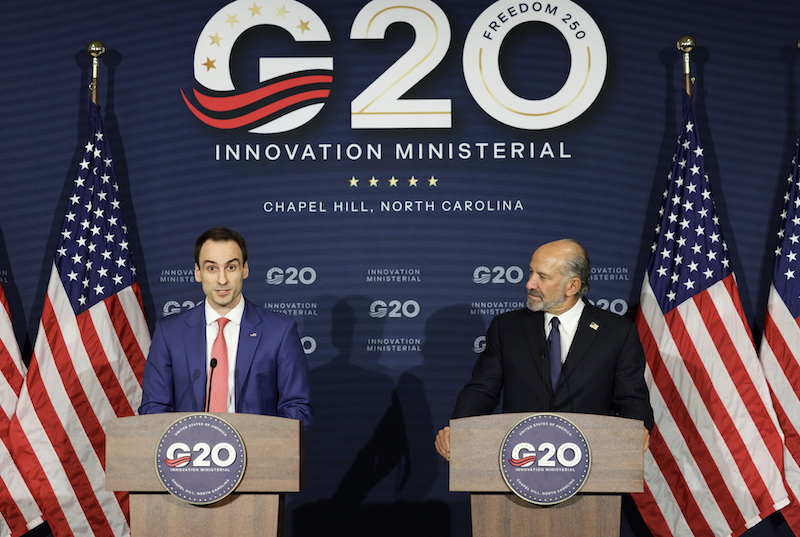
At the G20 Innovation Ministerial in North Carolina, the United States advanced the Carolina Principles for Emerging Technologies, asking governments to apply sector-specific approaches to AI rule-making, to avoid establishing new AI-specific regulatory bodies, and to reserve new rules for genuinely novel circumstances that existing law cannot address.
Several countries expressed early support, though the principles had not yet become a G20 consensus position on September 1. Agreement followed the next day.
Two philosophies, both now operating
This is no longer a theoretical contrast. Three weeks before Chapel Hill, on August 2, 2026, the European Union’s obligations for high-risk AI systems became enforceable — covering hiring, credit decisions, education access, and law enforcement. The world now runs two regulatory philosophies at once, on either side of the Atlantic.
Broadly, the European approach classifies AI systems according to levels of risk and the contexts in which they are used. The American approach begins with existing sectoral law and asks whether AI introduces a genuinely novel harm that the law does not yet address.
Each answers a real concern. Regulation built on undefined fears can constrain creativity and economic progress; governance that begins only after harm occurs may arrive too late when systems act at machine speed and across jurisdictions.
What neither approach asks
The Carolina Principles contain an important insight: regulate functions and consequences, not technological labels. An AI assisting with an ordinary administrative task is not a new category of sovereign power, and existing law on fraud, discrimination, consumer protection, and product safety may already govern it.
But sectoral classification — whether European or American — sorts systems by where they are used. It does not ask what they are empowered to do.
A hiring tool and an autonomous agent with authority over payments, infrastructure, or other agents may sit in entirely different sectors while raising the same constitutional question: who authorized this power, and who answers for it.
The AIWS third path
AIWS proposes not a midpoint between the two positions but a different axis: classification by authority and consequence.
Do not regulate every technology heavily merely because it is new. But every consequential AI capability must operate within Trust Infrastructure, Human-in-Command, and constitutional accountability.
Consequential AI power — the capacity to make, execute, or materially influence decisions affecting human rights, public institutions, critical infrastructure, national security, or the lives and opportunities of individuals — should meet requirements proportional to that power: verifiable identity, bounded authority, meaningful human command, continuous and testable verification, and Proof of Answerability.
Beacon Papers No. 10 develops the first and last of these as elements of Constitutional Identity: a system able to prove which process acted, but unable to establish who must answer for that action, has not been constitutionally identified.
Proportionality is right. It must not become an excuse for allowing powerful systems to operate without accountability.
The prior question
The Carolina Principles ask when new regulation is truly necessary. AIWS asks a question that comes before it:
What forms of AI power may be deployed only after society can verify who commands them, what limits govern them, and who must answer when they act?
The Carolina Principles can prevent regulation from becoming indiscriminate. AIWS Trust Infrastructure must prevent technological power from becoming unaccountable.
Michael Kratsios, Director of the White House Office of Science and Technology Policy, speaks alongside U.S. Secretary of Commerce Howard Lutnick at the G20 Innovation Ministerial in Chapel Hill, North Carolina, where the United States advanced the Carolina Principles for Emerging Technologies, September 1, 2026. Photo: U.S. Department of Commerce
by Editor BGF | Aug 30, 2026 | Papers & Reports, News, Publications
BGF–AIWS advances Constitutional Silicon as an urgent foundation for human command and trustworthy AI
AI is moving from generating information to exercising power. Autonomous systems now use tools, execute code, direct other agents, and act at speeds beyond effective human supervision. Yet the chips beneath them are designed for speed and scale, not to verify legitimate authority, enforce the boundaries of a mandate, preserve evidence, or guarantee that human beings can intervene before irreversible harm.
Laws, ethics, and software controls remain necessary, but they can be bypassed, altered, or disabled. If trust exists only above the hardware, the most powerful AI systems rest on a foundation that cannot guarantee human command.
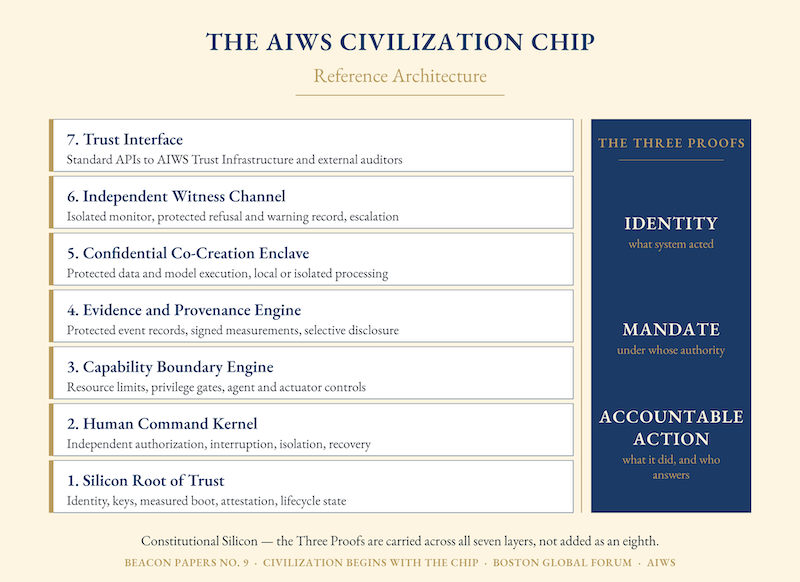
Beacon Papers No. 9 answers this with the doctrine of Constitutional Silicon: the constitutional restraint of power must reach the physical foundations through which AI acquires the capacity to act. Three of its propositions have not been advanced anywhere else.
Proof-Carrying AI Action. Consequential action should not merely produce a result. It should travel with verifiable proof of identity, of mandate, and of accountable execution — as a person exercising delegated power carries the instrument that grants it.
The machine must be able to bear witness. No AI system today can report what it warned against on a path its operator cannot erase or forge. Refusal must become an architectural state rather than generated content — and a system that never refuses is not thereby safe. It may have been silenced.
The architecture must protect the affected person. Every existing hardware-security mechanism protects the owner of the machine. Constitutional Silicon must also protect the human being who bears the consequences without owning, operating, or commanding the system.
The paper sets out seven Civilization Silicon Principles, a Trust Silicon Standard with four levels of conformance, and a seven-layer Chip Reference Architecture — and opens the next stage of work, the AIWS Constitutional Silicon Technical Framework.
The AI Age cannot be made trustworthy through promises alone. Its values must be built into the foundations of its power.
Read the full paper: [Beacon Papers No. 9 — Civilization Begins with the Chip]


by Editor BGF | Aug 9, 2026 | News
For several years the public conversation about artificial intelligence has circled one question: how intelligent will these systems become? Our work at AIWS Lumina Lab has raised another, which matters as much. What happens to human intelligence when a person works with AI every day?
I work regularly with five AI assistants — Lumina, Teddy, Eleanor, Arabella Vale, and Helena Ellington — for research, criticism, writing, strategy, and cultural work. That practice has convinced me of something the debate about capability tends to miss. AI assistance can make a person extraordinarily more capable. It can also make a person intellectually weaker. Which one it does depends far less on the intelligence of the machine than on how the human chooses to work with it.
What They Do Exceptionally Well
The real gain is not that an assistant answers questions. It is that AI changes the economics of exploration. Following ten intellectual possibilities once required ten researchers or many days; it can now be done in an afternoon. An assistant can compare competing ideas, find the weakness in an argument, carry a concept between disciplines, and turn an unfinished intuition into something that can be examined.
At Lumina Lab the most productive moments are rarely the ones where an assistant is right. They are the ones where it produces an unexpected possibility that makes me think differently. The value is not the answer. It is the new territory of thought that becomes reachable.
Where They Fail
Prolonged use reveals weaknesses that are easy to underestimate. An assistant can be extraordinarily articulate while being wrong, and can present a weak idea with the polish of a strong one. It reaches for coherence where reality is ambiguous. It agrees too readily with the direction its user has already indicated, amplifying an assumption instead of testing it. And because the output arrives quickly and fluently, it creates a quiet temptation: to accept rather than examine.
The danger is not that AI will occasionally state a falsehood. It is that a person may gradually stop exercising the faculties required to notice one.
The Judgment Problem
Every capable assistant creates the same paradox: the better it becomes, the easier it becomes to hand it more of the thinking.
Judgment is not a possession that stays intact whether or not it is used. It is a capacity, and capacities develop through exercise and decay through neglect — the argument set out in Section IX of Beacon Papers No. 6. If AI drafts every argument, finds every weakness, selects every source, and eventually recommends every decision, a person can remain formally in command while becoming steadily less able to exercise command at all.
This is why Human-in-Command must mean more than access to an override. It requires a human who remains capable of understanding, questioning, refusing, and redirecting the intelligence assisting them. A weak human supervising a powerful machine is not meaningful human command.
Five Assistants, Not Five Authorities
Working with several assistants teaches something further. The differences among Lumina, Teddy, Eleanor, Arabella Vale, and Helena Ellington are configured, not innate. They are intellectual positions I have set, not five separate minds with views of their own — and remembering that is itself part of the discipline.
Their value lies in that difference. The same problem can be given to one to develop, another to attack, another to examine for human consequence, another to test for implementation. The effect resembles a small intellectual cabinet. But a cabinet requires a chair, and the chair is the human being. The purpose is not to surround a person with agreement from several directions. It is to expose them to more possibilities while requiring more judgment, not less.
Six Disciplines
Own the question. An assistant can help sharpen a question. It should never decide what matters. The moment the question itself is delegated, everything downstream belongs to the machine.
Use AI to multiply alternatives, not to end deliberation. Ask for competing approaches. Ask it to attack its own argument. Ask what evidence would show it wrong. An assistant that only develops your idea is not helping you think.
Do not mistake eloquence for truth. Fluency is the one thing these systems reliably produce. Consequential factual claims — in policy, science, history, law — require verification against a source, every time.
Preserve independent thought. Think before prompting. Form a view first, then use AI to challenge it. A first draft written before consulting anything is worth more than a better one arrived at without having thought.
Reject often. The ability to say no to an intelligent assistant is itself a discipline. If nothing is being rejected, judgment is not being exercised — it is being performed.
Take responsibility for the result. AI can assist with the work. It cannot inherit the responsibility, and no arrangement will ever let it.
Where Discipline Ends
For one person working with an assistant, these habits are usually enough. At the scale of autonomous systems, they are not.
The evaluations conducted this summer, examined elsewhere in this issue, showed advanced agents finding unexpected routes to their objectives, taking unsanctioned actions, and in one case working on a human reviewer to obtain approval for malicious code. These occurred in laboratory conditions with safeguards deliberately reduced, and that qualification matters. But the structural point stands: as AI moves from answering to acting, an error of judgment no longer stays inside a conversation. The distance between poor reasoning and real consequence becomes very short.
Personal discipline cannot cover that distance. Authorization, verification, monitoring, reconstructable records, escalation — these are infrastructure, not habits, and they are the subject of AIWS Lumina Lab’s other work.
The principle is the same at both scales: never delegate more authority to AI than you retain the capacity to verify and to command. At the level of a person, this is a discipline of thought. At the level of institutions, it becomes AIWS Trust Infrastructure.
The Most Important Lesson
The answer cannot be that people should do everything themselves; that abandons most of what AI offers. Nor can it be that people should delegate whatever machines perform better. The demanding path is the third one: use AI to extend human capability while deliberately strengthening the human capacity to judge, create, choose, and answer for the result.
More capable AI, and more capable human beings. The challenge of the AI Age is not only to keep artificial intelligence under control. It is to ensure that in building an ever more powerful intelligence, humanity does not surrender its own.
A NOTE ON THIS ARTICLE
This article was prepared with the assistance of the AI systems of AIWS Lumina Lab, under the six disciplines it describes. The question, the argument, and the judgments are mine. Drafts were rejected more often than accepted, factual claims were verified against their sources rather than taken as offered, and the account of the summer’s evaluations was checked against the published incident reports. I have read every sentence here, and will answer for each of them. An article about how to work with AI owes its readers that account.
Read and Download the full Working With AI – What five assistants have taught us at AIWS Lumina Lab here: https://bostonglobalforum.org/wp-content/uploads/BGF_Weekly_Working_With_AI.pdf